
 Kontakt
 Kako nakupovati
Dostava
Svetovalec pri nakupu
 Angleščina
 117 b
117 b
 Novo
Novo
Do 30 dni za vračilo

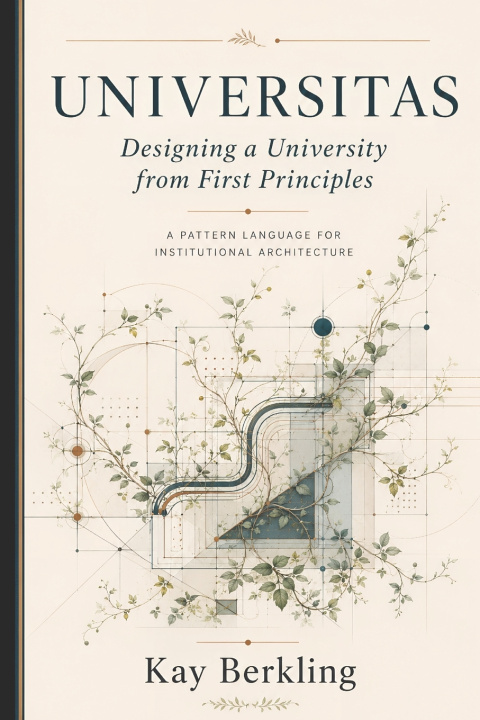
Universitas: Designing a University from First Principles begins with the oldest European university, Bologna, where students organised first and the institution followed. Looking at where we are today, something seems to have gotten lost along the way. Using principles of Software Engineering, the author develops a way of desinging the future of higher education from first principles.
The book argues that many recurring problems in universities are not caused by a lack of motivation, talent, or goodwill. They are produced by recurring patterns within structures and humans in historically grown organisations. Decisions take too long. Participation becomes symbolic. Innovation depends on individual champions. Flexible pathways become confusing. Recognition of prior learning remains unpredictable. Quality assurance documents process but does not always see learning. The same problems return across institutions, roles, and reform efforts because the architecture underneath has not changed.
Drawing on more than thirty years inside higher education, as student, lecturer, professor, programme designer, researcher, senator, equality officer, and reform participant across seven countries, Berkling combines lived institutional experience with a method borrowed from software architecture: design patterns.
At the heart of the book are blank-slate dialogues with experts who know higher education from different positions. Each was asked the same question: if money, politics, and IT constraints were solved issues, and you had the power to create a university from scratch, what would it look like?
The themes and principles derived from these conversations are translated into a pattern language for institutional design: recurring antipatterns that make universities fail predictably, and corresponding design patterns that show how they might be built differently.
The final part develops the Open University of Germany as a worked institutional prototype: a fictive but serious public university model designed for modular, stackable, lifelong learning. Its governance, curriculum, quality assurance, legal structure, finance, accreditation logic, and implementation documents are treated as one architecture based on design patterns and evaluated along a maturity signature of their design goals.
The book is written for university leaders, policymakers, accreditation experts, programme designers, academic staff, students, and institutional innovators who already sense that something in the system is not working as well as it could and need a language precise enough to name it.
A university does not become learner-centred because of a single statment or vision. It becomes learner-centred when its structures are designed to survive budgets, committees, leadership changes, legal constraints, and time.
This book proposed the design patterns and an implementation that any new university can give itself and any historical university can evaluate itself against, set goals and measure it's own maturity against those goals. Just like the class desing patterns in Software Engineering, this book is intended as a reference catalogue and the Open University of Germany as an implementable prototype.


O knjigi
Angleščina

Podarite to knjigo še danes
To je povsem preprosto
1 Dodajte knjigo v košarico in izberite dostavo kot darilo 2 V zameno vam bomo poslali kupon 3 Knjiga bo dostavljena na naslov obdarovancaPozdravljeni! Sem Libroamiko, vaš knjižni svetovalec.
Kako vam lahko pomagam?