
 Kontakt
 Kako nakupovati
Dostava
Svetovalec pri nakupu
 Angleščina
 16 b
16 b
 Novo
Novo
Do 30 dni za vračilo

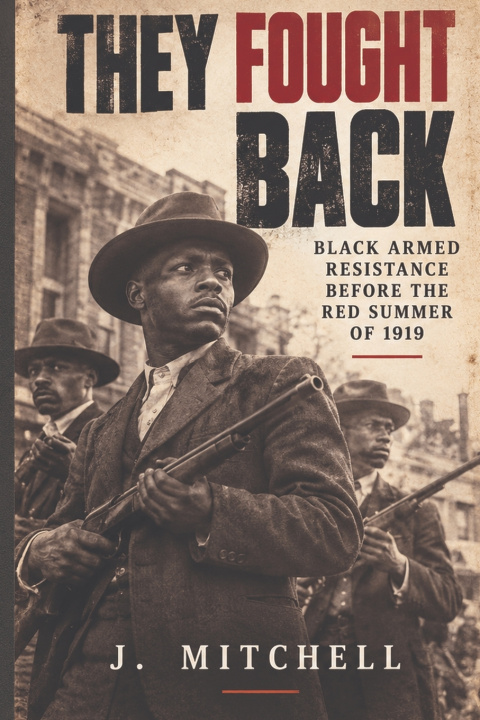
Before the Red Summer of 1919, Black Americans had already spent decades defending their homes, businesses, political rights, families, and communities against racial violence.
They Fought Back examines a series of confrontations from Reconstruction through the First World War, including Colfax, the People's Grocery in Memphis, Robert Charles and New Orleans, Springfield, East St. Louis, and the Houston uprising of 1917.
The book does not treat every armed act as morally equivalent. Instead, J. Mitchell examines who initiated violence, what threats existed, who became a target, how authorities responded, and where self-defense crossed into retaliation or revolt.
Ida B. Wells provides another form of resistance through investigation, publication, organization, and her defense of the right to protect life when the law failed. The book also restores women, families, migration, protest, and community survival to a history too often reduced to gun battles.
With footnotes, a historical timeline, profiles of key people and organizations, an essay on sources and method, and a bibliography, They Fought Back traces a longer history of Black resistance before the better-known conflicts of 1919.
Introduction: More Than One Kind of Resistance
Introduces the book's central question and the different forms Black resistance took when public authorities failed to provide protection.
Chapter 1: Colfax: Defending a Ballot with Rifles
Examines the armed defense of political authority at Colfax in 1873 and the violence that followed.
Chapter 2: The People's Grocery: A Store Under Siege
Explores the armed defense of the People's Grocery in Memphis and the events leading to the lynching of its owners.
Chapter 3: Ida B. Wells and the Argument for Self-Defense
Looks at Wells's investigation of lynching and her controversial argument that Black Americans had a right to defend their lives.
Chapter 4: Robert Charles: Resistance, Pursuit, and Retaliation
Reconstructs the Robert Charles confrontation in New Orleans and examines where resistance, pursuit, and retaliation intersected.
Chapter 5: Springfield: Homes Behind the Firing Line
Examines Black residents who defended homes and neighborhoods during the Springfield violence of 1908.
Chapter 6: East St. Louis: "Hot Lead" from the Race Quarters
Studies armed resistance amid the devastating racial violence in East St. Louis in 1917.
Chapter 7: Houston: When Defense Became Revolt
Examines the Houston uprising of 1917 and the difficult boundary between self-defense, retaliation, and revolt.
Chapter 8: The Unequal Meaning of Order
Considers how law, policing, and government authority operated differently depending on who was threatened and who resisted.
Chapter 9: Women, Families, and the Work of Survival
Broadens resistance beyond firearms to include women, families, migration, mutual aid, protest, and community survival.
Conclusion: Before the Red Summer
Brings the cases together and asks what citizens could do when government claimed their loyalty but failed to secure their lives.
Timeline
Places the major events in chronological context.
People and Organizations
Provides a quick reference to important individuals, institutions, and groups appearing in the book.
Essay on Sources and Method
Explains how the evidence was evaluated and why uncertainty and conflicting accounts matter to the history.
Bibliography
Documents the works used to support the study.


O knjigi
Angleščina

Podarite to knjigo še danes
To je povsem preprosto
1 Dodajte knjigo v košarico in izberite dostavo kot darilo 2 V zameno vam bomo poslali kupon 3 Knjiga bo dostavljena na naslov obdarovancaPozdravljeni! Sem Libroamiko, vaš knjižni svetovalec.
Kako vam lahko pomagam?