
 Kontakt
 Kako nakupovati
Dostava
Svetovalec pri nakupu
 Angleščina
 24 b
24 b
 Novo
Novo
30 dni za vračilo blaga

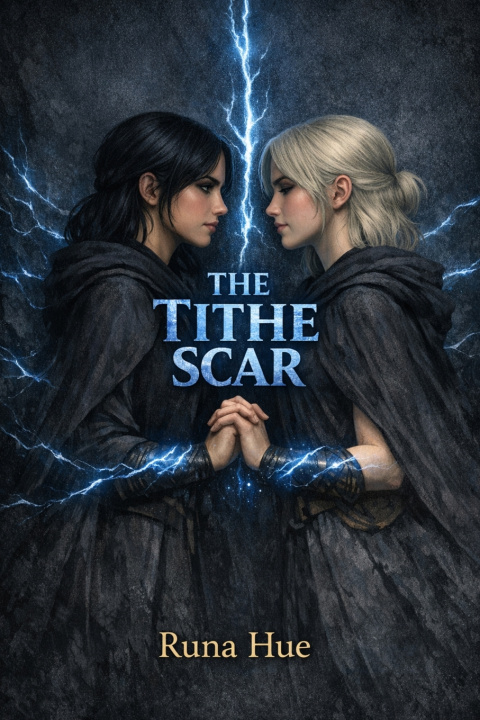
TITHE SCAR: The Scar Where Her Sister Lives
Veyra Thoss is a structural engineer who understands load-bearing walls. When her sister Isolde is dying and the only viable treatment belongs to the Carth Court - a powerful institution that trades in debt measured not in money but in bodies, in years, in the resonance of living things - Vey reads every page of the contract, finds the seam on page seven, confirms there is no alternative, and signs it anyway. Her hands do not shake. She has decided they will not.
The debt mark settles into her wrist like a second heartbeat running in the wrong body.
Isolde survives. Vey pays. The cost is not what she expected and also exactly what she expected, because she read the terms and the terms were clear and clarity, it turns out, is not the same as preparation.
Told nonlinearly - structured around the weight of events rather than their chronology - Tithe Scar moves between Day 1, when Vey signs the contract in a hospital room while her sister is still warm, and Day 338, and the years between and after, circling the same catastrophe from different angles the way memory does, the way grief does, the way a scar does when the weather turns.
At the center of the story is the relationship between the sisters: Isolde, who came back from somewhere she was not supposed to return from, who now lives partly in Vey's blood, who speaks through the scar on Vey's forearm in the moments when the living and the not-quite-dead press close together. And Vey, who has spent her entire life being the load-bearing wall - the one who calculates, who checks the records room, who maps the problem in a structural notebook before she allows herself to feel it.
Sorin moves through the story at Vey's side: a man who made his own arrangement with the Court, who carries a clock in his chest on behalf of someone he would not let pay the full price alone. He and Vey have built a language out of hands and silence and the careful not-asking of questions that don't need answering yet.
Drevna Carth, the Court's principal, is the book's antagonist - and one of its most precise creations. She is not wrong about everything. She knows she is not wrong about everything. The system she runs is predatory and also, for many of the people inside it, the only option available, and she holds both of those facts with the ease of someone who made her peace with that coexistence a long time ago.
Beneath all of it: the catacombs. Three levels below the city, limestone passages that breathe with a rhythm older than the Court, older than the family that built above them. The walls expand and contract. If you stand there long enough, you stop choosing when to inhale. Vey, by the end, cannot find the boundary between herself and the stone.
Tithe Scar is a secondary-world fantasy about what it costs to love someone inside a system designed to monetize that love. About the specific violence of a contract that arrives when refusal has been made to feel irrational. About women who survive things they were not built to survive and are changed by the surviving - not broken, not healed, but restructured. Carrying something they could not have carried alone. Still carrying it.
The scars in this book speak. Eventually, if you are paying attention, so does everything else.


O knjigi
Angleščina
