
 Kontakt
 Kako nakupovati
Dostava
Svetovalec pri nakupu
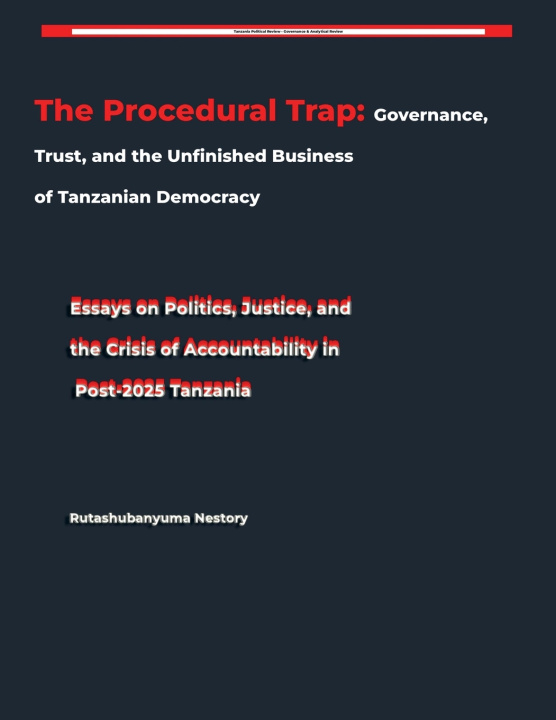
The Procedural Trap
Governance, Trust, and the Unfinished Business of Tanzanian Democracy Essays on Politics, Justice, and the Crisis of Accountability in Post-2025 Tanzania
 Angleščina
 54 b
54 b
 Kmalu
Kmalu
 Novo
Novo
Do 30 dni za vračilo

What happens when democratic procedures become substitutes for democratic substance?
In the aftermath of Tanzania's contested 2025 elections, a pattern has emerged across the country's political and institutional landscape: formal processes increasingly function as barriers to accountability rather than pathways to justice. The Procedural Trap offers a critical examination of this phenomenon through thirty-one essays spanning constitutional reform, political succession, economic governance, electoral justice, policing, and administrative accountability.
From the funeral in Siha where mourners placed a coffin on the District Commissioner's vehicle to demand the release of arrested colleagues, to the prolonged failure to compensate Kagera war veterans more than four decades after their service, to shifting official narratives surrounding Tanzania's gold reserves-these essays illuminate a governance environment where procedure often displaces justice, and institutional continuity is frequently prioritised over democratic transformation.
The collection examines rising tensions within Tanzania's ruling party as succession politics intensify ahead of the 2030 transition, the strategic calculations of opposition parties engaging with Zanzibar's Government of National Unity framework, and a constitutional reform debate that risks repeating the limitations of the 2014 process, where broad consultation produced limited structural change.
Drawing on parliamentary records, court rulings, policy statements, and public reporting, the author shows how actors across the political spectrum employ proceduralism both as a tool of governance and as a mechanism of containment. Meetings, timelines, legal thresholds, and evidentiary rules frequently become the very instruments through which substantive accountability is delayed or denied.
The Procedural Trap is essential reading for scholars of Tanzanian politics, legal practitioners, civil society actors, journalists, and citizens concerned with the future of democratic governance. It offers neither partisan polemic nor easy prescriptions, but instead a sustained analytical account of how institutional form can drift away from democratic purpose-and what is at stake when it does.
Ultimately, the book argues that democratic institutions must be evaluated not by the elegance of their procedures, but by whether those procedures produce justice, accountability, and meaningful public participation.


O knjigi
Angleščina

Podarite to knjigo še danes
To je povsem preprosto
1 Dodajte knjigo v košarico in izberite dostavo kot darilo 2 V zameno vam bomo poslali kupon 3 Knjiga bo dostavljena na naslov obdarovancaPozdravljeni! Sem Libroamiko, vaš knjižni svetovalec.
Kako vam lahko pomagam?