
 Kontakt
 Kako nakupovati
Dostava
Svetovalec pri nakupu
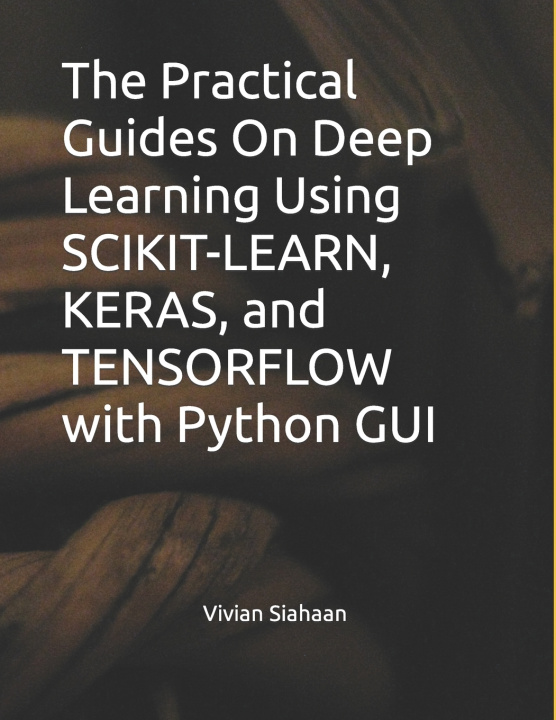
The Practical Guides On Deep Learning Using SCIKIT-LEARN, KERAS, and TENSORFLOW with Python GUI
 Angleščina
 84 b
84 b
30 dni za vračilo blaga
Morda bi vas zanimalo tudi

 /
/
 Mehka
Mehka
 46.07
€
46.07
€

In this book, you will learn how to use TensorFlow, Keras, Scikit-Learn, OpenCV, Pandas, NumPy and other libraries to implement deep learning on recognizing traffic signs using GTSRB dataset, detecting brain tumor using Brain Image MRI dataset, classifying gender, and recognizing facial expression using FER2013 dataset
In Chapter 1, you will learn to create GUI applications to display image histogram. It is a graphical representation that displays the distribution of pixel intensities in an image. It provides information about the frequency of occurrence of each intensity level in the image. The histogram allows us to understand the overall brightness or contrast of the image and can reveal important characteristics such as dynamic range, exposure, and the presence of certain image features.
In Chapter 2, you will learn how to use TensorFlow, Keras, Scikit-Learn, Pandas, NumPy and other libraries to perform prediction on handwritten digits using MNIST dataset. The MNIST dataset is a widely used dataset in machine learning and computer vision, particularly for image classification tasks. It consists of a collection of handwritten digits from zero to nine, where each digit is represented as a 28x28 grayscale image. The dataset was created by collecting handwriting samples from various individuals and then preprocessing them to standardize the format. Each image in the dataset represents a single digit and is labeled with the corresponding digit it represents. The labels range from 0 to 9, indicating the true value of the handwritten digit.
In Chapter 3, you will learn how to perform recognizing traffic signs using GTSRB dataset from Kaggle. There are several different types of traffic signs like speed limits, no entry, traffic signals, turn left or right, children crossing, no passing of heavy vehicles, etc. Traffic signs classification is the process of identifying which class a traffic sign belongs to. In this Python project, you will build a deep neural network model that can classify traffic signs in image into different categories. With this model, you will be able to read and understand traffic signs which are a very important task for all autonomous vehicles. You will build a GUI application for this purpose.
In Chapter 4, you will learn how to perform detecting brain tumor using Brain Image MRI dataset. Following are the steps taken in this chapter: Dataset Exploration: Explore the Brain Image MRI dataset from Kaggle. Describe the structure of the dataset, the different classes (tumor vs. non-tumor), and any preprocessing steps required; Data Preprocessing: Preprocess the dataset to prepare it for model training. This may include tasks such as resizing images, normalizing pixel values, splitting data into training and testing sets, and creating labels; Model Building: Use TensorFlow and Keras to build a deep learning model for brain tumor detection. Choose an appropriate architecture, such as a convolutional neural network (CNN), and configure the model layers; Model Training: Train the brain tumor detection model using the preprocessed dataset. Specify the loss function, optimizer, and evaluation metrics. Monitor the training process and visualize the training/validation accuracy and loss over epochs; Model Evaluation: Evaluate the trained model on the testing dataset. Calculate metrics such as accuracy, precision, recall, and F1 score to assess the model's performance; and so on.
In Chapter 5, you will learn how to perform classifying gender using dataset provided by Kaggle using MobileNetV2 and CNN models. The details are in the book.
In Chapter 6, you will learn how to perform recognizing facial expression using FER2013 dataset using CNN model. The FER2013 dataset contains facial images categorized into seven different emotions: anger, disgust, fear, happiness, sadness, surprise, and neutral. The details are in the book.


O knjigi
Angleščina
