
 Kontakt
 Kako nakupovati
Dostava
Svetovalec pri nakupu
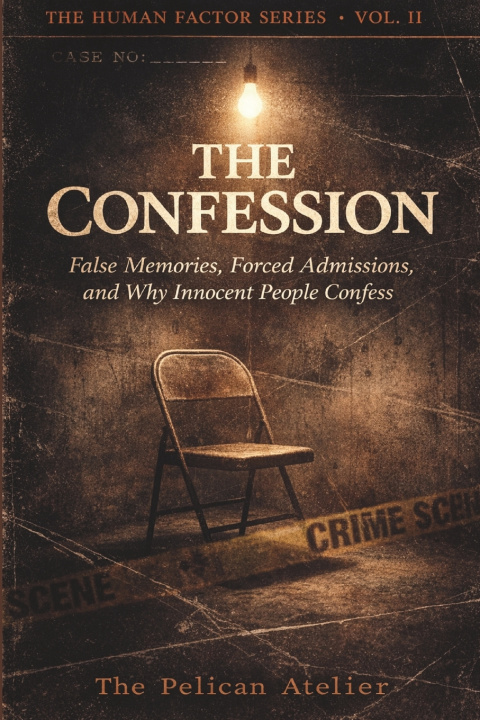
The Confession
alse Memories, Forced Admissions, and Why Innocent People Confess The Human Factor Series Volume II
 Angleščina
 30 b
30 b
Do 30 dni za vračilo

Memory is not a recording.
It is a reconstruction.
The Confession explores one of the most unsettling discoveries in cognitive science: people can remember events that never happened, and innocent individuals can confess to crimes they did not commit.
Through documented legal cases and psychological research, this book reveals how memory distortion, interrogation pressure, and cognitive bias can transform uncertainty into confident but false testimony.
Each chapter presents real-world cases drawn from court records, scientific research, and investigative journalism. Readers examine the evidence, analyze the mechanisms behind memory failure, and confront a difficult question: how much can we trust our own recollections?
Inside this book you will explore:
How false memories are created through suggestion and misinformation
Why eyewitness testimony can be confident but incorrect
The psychology of interrogation techniques that produce false confessions
How cognitive biases influence investigators, witnesses, and juries
The role of DNA evidence in revealing systemic failures in criminal justice
The psychological mechanisms behind wrongful convictions
The book is structured around analytical puzzles that guide readers through real cases. Each case moves through three stages: recalling the facts, analyzing the mechanism, and reconstructing what the evidence truly means.
Rather than presenting simple conclusions, The Confession invites readers to think like a forensic psychologist and examine how memory, belief, and authority interact under pressure.
This volume is ideal for readers interested in:
Cognitive psychology
Criminal justice and wrongful convictions
Memory science and human error
Forensic psychology
Critical thinking and analytical reasoning
The Confession is the second volume in The Human Factor Series, a collection of books exploring how human cognition shapes belief, decision making, and error.
Perfect for students, psychology enthusiasts, and readers who want to understand the hidden mechanisms behind memory, testimony, and confession.
What's Inside (Bullet Section)
Documented cases of false confessions and wrongful convictions
Psychological research on memory distortion and cognitive bias
Real interrogation scenarios analyzed through behavioral science
Structured puzzles that challenge the reader's reasoning
Evidence-based insights from cognitive psychology and legal studies
Who This Book Is For
Students of psychology and criminology
Readers interested in true crime and investigative analysis
Professionals in law enforcement, law, or forensic science
Anyone curious about how memory and belief can be misleading
Perfect Gift For
Psychology students
True crime readers
Law and criminology enthusiasts
Critical thinking learners
Readers interested in human behavior and decision making


O knjigi
Angleščina

Podarite to knjigo še danes
To je povsem preprosto
1 Dodajte knjigo v košarico in izberite dostavo kot darilo 2 V zameno vam bomo poslali kupon 3 Knjiga bo dostavljena na naslov obdarovancaPozdravljeni! Sem Libroamiko, vaš knjižni svetovalec.
Kako vam lahko pomagam?