
 Kontakt
 Kako nakupovati
Dostava
Svetovalec pri nakupu
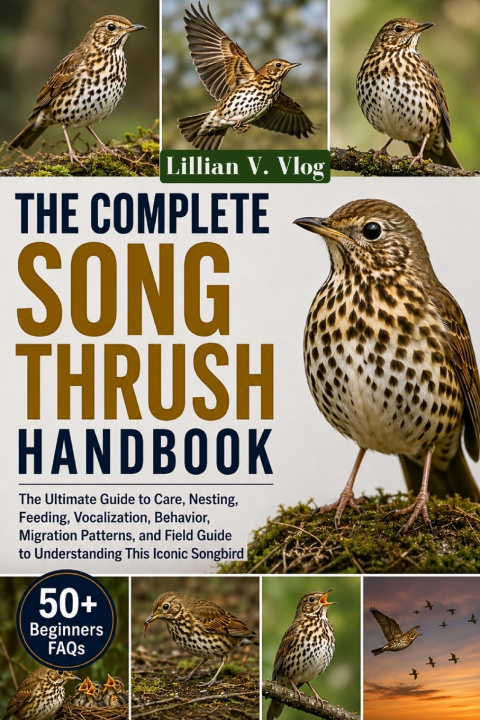
THE COMPLETE SONG THRUSH HANDBOOK
The Ultimate Guide to Care, Nesting, Feeding, Vocalization, Behavior, Migration Patterns, and Field Guide to Understanding This Iconic Songbird
 Angleščina
 Novo
Novo
Morda bi vas zanimalo tudi












INTRODUCTION TO THE SONG THRUSH
The Song thrush is one of the most familiar and widely admired songbirds across Europe and parts of Asia, and it has also been introduced to other regions such as New Zealand and Australia. Known for its distinctive, melodious, and repetitive song, this small brown bird has long captured the attention of naturalists, poets, gardeners, and bird enthusiasts. Its presence in woodlands, farmlands, hedgerows, parks, and even urban gardens makes it one of the most accessible wild birds for human observation.
1. Understanding the Song Thrush as a Species
The song thrush belongs to the thrush family, scientifically known as Turdidae. It is a medium-sized passerine bird, typically measuring around 20-23 cm in length with a wingspan of approximately 33-36 cm. Its plumage is generally warm brown on the upperparts, with a cream or pale yellow underside marked with distinctive dark, arrow-shaped spots.
Although it may appear plain at first glance, the song thrush possesses subtle beauty. Its spotted chest pattern is one of its most recognizable features, helping birdwatchers distinguish it from similar species such as the mistle thrush or blackbird. Its posture is upright and alert, with a relatively short tail compared to its body size.
The song thrush is not only recognized for its appearance but also for its ecological adaptability. It thrives in a wide range of habitats, from dense forests to suburban gardens. This adaptability has contributed significantly to its widespread distribution and long-term survival.
2. Historical Recognition and Human Awareness
Humans have observed and recorded the song thrush for centuries. In European natural history, it has often been associated with the arrival of spring due to its early morning singing behavior. Ancient texts and medieval writings frequently mention thrushes as symbols of renewal and natural harmony.
In rural communities, the bird was historically seen as a beneficial presence because it feeds on insects and pests that damage crops and gardens. Farmers often welcomed its presence near orchards and fields, where it helped control populations of snails, worms, and other invertebrates.
Over time, the song thrush became a subject of artistic inspiration. Poets such as Thomas Hardy and others in the Romantic tradition referenced its song as a symbol of melancholy beauty and natural simplicity. Its repetitive musical phrases were often interpreted as a reflection of human emotion, particularly longing and reflection.
3. Physical Characteristics and Identification
The song thrush is a compact and well-proportioned bird. Its most defining features include:
- Coloration: Warm brown upper body with a slightly reddish tone in some individuals
- Underparts: Creamy white or pale yellow with dark, teardrop-shaped spots
- Beak: Short, strong, and yellowish-brown, adapted for breaking snail shells
- Eyes: Dark and expressive, giving an alert appearance
- Legs: Pale pink or light brown, suited for ground foraging
Juvenile song thrushes tend to have less defined spotting and a slightly more muted coloration, which becomes more distinct as they mature.
4. Habitat Preferences and Environmental Adaptability
The song thrush is highly adaptable and can be found in a variety of habitats. It is commonly associated with:
- Woodlands with dense undergrowth
- Hedgerows and farmland edges
- Urban parks and suburban gardens
- Orchards and open grassy areas.


O knjigi
Angleščina

Podarite to knjigo še danes
To je povsem preprosto
1 Dodajte knjigo v košarico in izberite dostavo kot darilo 2 V zameno vam bomo poslali kupon 3 Knjiga bo dostavljena na naslov obdarovancaPozdravljeni! Sem Libroamiko, vaš knjižni svetovalec.
Kako vam lahko pomagam?