
 Kontakt
 Kako nakupovati
Dostava
Svetovalec pri nakupu
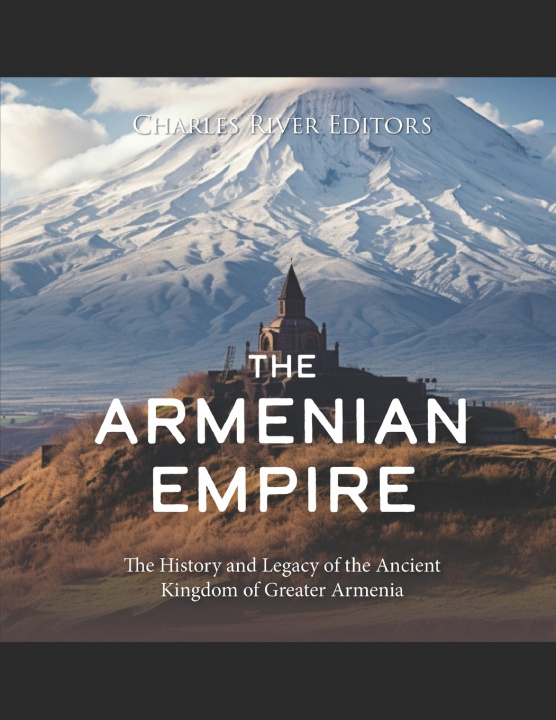
The Armenian Empire
The History and Legacy of the Ancient Kingdom of Greater Armenia
 Angleščina
 26 b
26 b
Do 30 dni za vračilo

For a time, Seleucus I and his successors commanded the largest empire in the world as it stretched from the high plains and deserts of what is now Afghanistan in the east to parts of the Levant and Asia Minor in the west. The empire's early kings were strong and shrewd and committed to the ideas of Hellenism as much as holding power and expanding the realm of their empire, but later rulers did not prove as capable. In time, the Seleucid royal house often descended into orgies of violence which were driven by ambitious men and women.
One general tied to the Seleucids was Artaxias, who founded the Artaxiad dynasty and managed to unite various Armenian regions under his rule and establish a strong central government, which enabled him to wage successful military campaigns against neighbouring powers. Artaxias I the Pious also built the capital city of Artaxata, which became a cultural and economic centre for the Armenian people. The succeeding kings of the Artaxiad dynasty continued to expand the territory of Greater Armenia, which at its height, stretched from the Black Sea to the Caspian Sea and from the Caucasus Mountains to the Mediterranean Sea.
During the reign of the Artaxiad dynasty, Armenia became a hub of trade and commerce, connecting the Silk Road and the Mediterranean world. The Armenian kings encouraged the development of agriculture, commerce, and arts, and the kingdom became renowned for its skilled artisans, writers, and philosophers. Of course, given its central location, the dynasty also faced numerous challenges, including repeated invasions by the Roman and Parthian empires, internal conflicts, and economic hardships. The dynasty's resilience and adaptability enabled it to survive for nearly two centuries, leaving behind a rich cultural and political legacy that has endured in the region, even as its historical memory was overshadowed by its more powerful neighbors. After the collapse of the Artaxiad dynasty (at the onset of the 1st century BCE), Rome and the kingdom of Parthia engaged in a competition for political influence in the vast territory of Greater Armenia. The Parthian Arshakunis endeavored to expel Rome from the region, aiming to establish the dominance of their own lineage. The political strategy devised by Parthian King Artabanus III, however, remained unrealized, as his sons Vorodes and Arshak I, who held the throne in Great Armenia, were deposed due to the intervention of the Roman Emperor Tiberius. By inciting the Alban, Georgian, and other neighboring tribes against the Armenians, Tiberius facilitated the ascendancy of Mithridates, the brother of Iberian King Pharasmanes, to the throne of Greater Armenia in the year 36.
With the approval of the Roman emperor, the Goderdzak province of Greater Armenia was annexed to Iberia in 37, and Armenian Mesopotamia was incorporated into Adiabene. Simultaneously, Tiberius elevated the Armenian kingdoms of Commagene and Lesser Armenia to the status of Roman territories. Tiberius's anti-Armenian stance further exacerbated the discontent and animosity of the Armenian populace towards Rome. Consequently, in 37, the Armenians revolted and, under the leadership of General Demonax, successfully overthrew Mithridates of Iberia, expelling him from their land. The newly crowned Roman Emperor Caligula acknowledged the sovereignty of Greater Armenia and reinstated the kingdoms of Lesser Armenia and Commagene. Caligula's successor, Claudius, continued to follow the political trajectory of Tiberius in relation to Armenia. In 43, with the combined forces of Rome and Iberia, he once again installed Mithridates on the throne of Greater Armenia. However, Mithridates was neither acknowledged by nor received support from the Armenians. The Armenians responded with indifference to the assassination of Mithridates in the year 51 by his nephew and son-in-law, Rhadamistus.


O knjigi
Angleščina
Kategorije

Podarite to knjigo še danes
To je povsem preprosto
1 Dodajte knjigo v košarico in izberite dostavo kot darilo 2 V zameno vam bomo poslali kupon 3 Knjiga bo dostavljena na naslov obdarovancaPozdravljeni! Sem Libroamiko, vaš knjižni svetovalec.
Kako vam lahko pomagam?