
 Kontakt
 Kako nakupovati
Dostava
Svetovalec pri nakupu
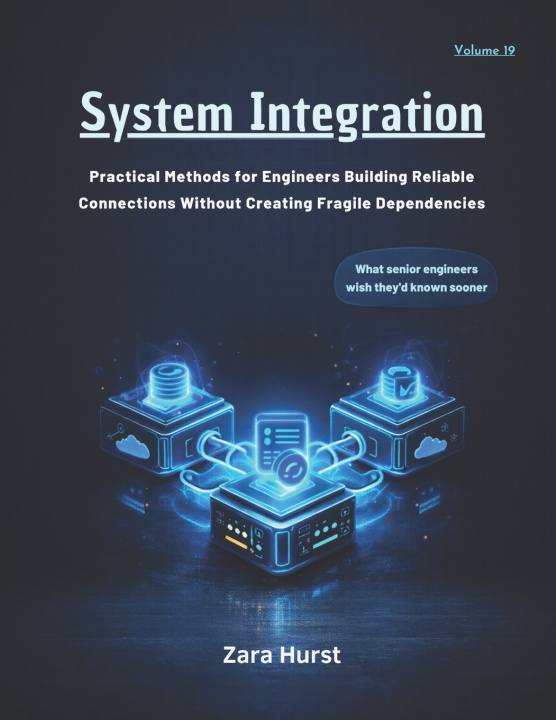
System Integration
Volume 19: Practical Methods for Engineers Building Reliable Connections Without Creating Fragile Dependencies
 Angleščina
 34 b
34 b
 Novo
Novo
30 dni za vračilo blaga

Build Systems That Connect , Without Creating Tomorrow's Headaches
Have you ever inherited an integration that worked perfectly until it didn't? The kind where changing one thing breaks three others, and nobody remembers why System A talks directly to System B?
You're not alone. Every engineer who's worked with connected systems has felt this frustration.
Here's what I've learned after years of building and maintaining integrations: Most problems aren't technical failures. They're assumption failures. The undocumented data formats, the optimistic timeouts, the error handling that doesn't handle much , these cause the 3 AM emergencies.
This book isn't another academic text on integration theory. It's a practical field guide from someone who's made the mistakes so you don't have to.
Why This Book Is Different:
Most integration books fall into two camps: too theoretical to help when things break, or too vendor-specific to be useful if you change cloud providers. This one lives in the middle , cloud-agnostic, pattern-focused, and built around the actual decisions engineers make every day.
What You'll Discover Inside:
Part One explains why integrations actually fail , the human reasons, the assumptions, the questions nobody asked at the beginning.
Part Two walks through integration approaches without the religious wars. Synchronous, asynchronous, event-driven , each has its place.
Part Three tackles data: contracts, schema evolution, consistency without transactions.
Part Four covers building for production: error handling, testing, APIs that age gracefully.
Part Five addresses monitoring, debugging across boundaries, and security.
Part Six tackles scaling and , just as importantly , deprecating integrations gracefully.
What You'll Learn:
• Why integrations break and how to prevent the four root causes
• Questions to ask before writing any code (saves months of rework)
• When synchronous makes sense and when it creates hidden dependencies
• How asynchronous communication decouples services effectively
• The real difference between events and commands
• Data contracts that prevent silent corruption
• Schema evolution without breaking existing consumers
• Saga patterns for consistency without distributed transactions
• Error handling strategies that make failures visible
• Testing approaches that fit real budgets
• Monitoring that tells you what's broken and where to look
• Debugging when the problem lives in someone else's code
• Security fundamentals at integration points
• How to deprecate integrations without turning users away
From One Engineer to Another:
I've been where you are. Staring at diagrams that look like spaghetti. Getting paged at 2 AM because one team changed an API and forgot to tell anyone. This book came from those experiences , from what actually worked when things were on fire and from what prevented the fires in the first place.
If you're ready to build integrations that last , connections you can trust, systems you can change, and fewer 3 AM emergencies , scroll up and click the button.
Your future self will thank you.


O knjigi
Angleščina

Podarite to knjigo še danes
To je povsem preprosto
1 Dodajte knjigo v košarico in izberite dostavo kot darilo 2 V zameno vam bomo poslali kupon 3 Knjiga bo dostavljena na naslov obdarovancaPozdravljeni! Sem Libroamiko, vaš knjižni svetovalec.
Kako vam lahko pomagam?