
 Kontakt
 Kako nakupovati
Dostava
Svetovalec pri nakupu
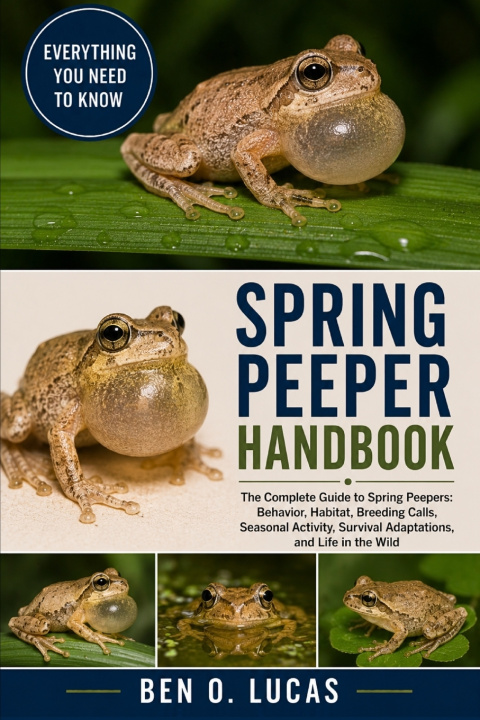
SPRING PEEPER HANDBOOK
The Complete Guide to Spring Peepers: Behavior, Habitat, Breeding Calls, Seasonal Activity, Survival Adaptations, and Life in the Wild
 Angleščina
 37 b
37 b
 Novo
Novo
Do 30 dni za vračilo

INTRODUCTION TO THE SPRING PEEPER
Overview of the Species
The spring peeper, scientifically known as Pseudacris crucifer, is one of the most recognizable small amphibians in North America, not because of its size or striking physical presence, but because of its unmistakable voice. This tiny tree frog, often no larger than a person's thumb, carries a sound that defines the arrival of spring across forests, wetlands, and rural landscapes. Long before people notice leaves returning to trees or flowers pushing through the soil, the sharp, high-pitched "peep" of this frog begins to echo through the night air, signaling a seasonal transition that has repeated itself for countless generations.
Despite its small stature, the spring peeper holds a remarkable ability to thrive in a wide range of environments. It is commonly found in deciduous forests, swamps, marshes, and near temporary ponds, where it blends almost perfectly into its surroundings. Its coloration, typically a mix of light brown, tan, or gray, allows it to mimic tree bark and leaf litter so effectively that it often remains invisible even when it is only inches away. This natural camouflage is one of its most important survival tools, protecting it from predators while allowing it to remain active in exposed environments.
The most distinctive physical feature of the spring peeper is the dark "X"-shaped marking across its back, a pattern that has become a key identifying trait for people who encounter this species. Combined with its relatively smooth skin, large toe pads for climbing, and slender body, the frog is perfectly adapted for life both on the ground and among low vegetation. While it is technically classified as a tree frog, it spends much of its time in leaf litter, under logs, or hidden among grasses, emerging more prominently during the breeding season.
What makes the spring peeper truly remarkable is not just its adaptability, but its resilience. It is capable of surviving freezing winter temperatures in a way that seems almost impossible. During colder months, these frogs enter a state where their bodies partially freeze, with ice forming in their tissues. Yet, through specialized biological mechanisms, they are able to survive this process and thaw out when temperatures rise, resuming normal activity as if nothing had happened. This extraordinary adaptation allows them to occupy regions that experience harsh winters, expanding their range far beyond what many amphibians can tolerate.
The presence of the spring peeper in an environment is often subtle in physical terms but powerful in auditory terms. On warm spring nights, especially after rainfall, entire populations gather around breeding ponds and begin calling in unison. The resulting chorus can be so loud that it fills entire landscapes, creating a natural soundscape that is both vibrant and overwhelming. For many people, this sound is deeply tied to memory and seasonal awareness, becoming a natural signal that winter has ended and life is returning.
Scientific Classification
The spring peeper belongs to the family of tree frogs known as Hylidae, a group characterized by their climbing abilities and specialized toe pads that allow them to grip surfaces with precision. Within this family, it is part of the genus Pseudacris, which includes several small chorus frogs known for their vocal behavior. The full scientific classification of the spring peeper places it within the broader structure of amphibian life, connecting it to a long evolutionary history that dates back hundreds of millions of years.


O knjigi
Angleščina

Podarite to knjigo še danes
To je povsem preprosto
1 Dodajte knjigo v košarico in izberite dostavo kot darilo 2 V zameno vam bomo poslali kupon 3 Knjiga bo dostavljena na naslov obdarovancaPozdravljeni! Sem Libroamiko, vaš knjižni svetovalec.
Kako vam lahko pomagam?