
 Kontakt
 Kako nakupovati
Dostava
Svetovalec pri nakupu
 Angleščina
 87 b
87 b
 Kmalu
Kmalu
 Novo
Novo
Do 30 dni za vračilo

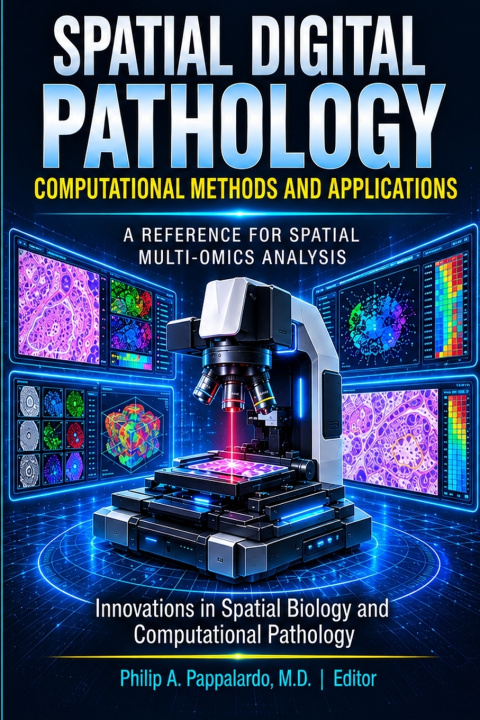
Spatial Digital Pathology: Computational Methods and Applications presents an integrated framework for understanding how laser capture microdissection (LCM), digital pathology, artificial intelligence, multimodal imaging, and spatial multi-omics are converging to enable increasingly precise molecular analysis of tissue.
Beginning with the foundations of LCM, the book traces the evolution from traditional microscopic tissue isolation to digitally guided and AI-assisted approaches. It examines the challenges of tissue selection, spatial context, molecular preservation, imaging, and data integration that have historically limited the ability to connect tissue morphology with molecular information.
The book then explores computational and AI-enabled approaches to digital pathology and LCM, including whole-slide imaging, image analysis, virtual histological staining, cell and tissue segmentation, spatial coordinate systems, and emerging pathology foundation models. Particular attention is given to workflows that connect computational image analysis with targeted physical tissue extraction and downstream molecular characterization.
Later chapters examine emerging integrations involving multimodal imaging, mass spectrometry imaging, spatial transcriptomics, spatial proteomics, and Deep Visual Proteomics. The discussion extends to computational reconstruction of three-dimensional tissue architecture and the development of spatial molecular maps that can support increasingly sophisticated biological investigations.
A central theme is the transition from conventional pathology workflows toward Spatial Digital Pathology-an approach in which tissue morphology, spatial coordinates, computational analysis, targeted microdissection, and molecular measurements are treated as components of a connected analytical system.
The book also introduces conceptual and emerging platform architectures, including AI-assisted LCM workflows, CODA-based three-dimensional spatial reconstruction, and proposed integrations of computational pathology with molecular-structure and regulatory-genomics models. These concepts are presented as developing technologies and research directions rather than established clinical standards.
Topics covered include:
• Laser capture microdissection and its evolution
• Digital and whole-slide imaging-guided LCM
• Artificial intelligence for tissue and cell identification
• Virtual histological staining and computational imaging
• Pathology foundation models and image analysis
• Multimodal optical and molecular imaging
• Mass spectrometry imaging and spatial molecular analysis
• Deep Visual Proteomics and spatial proteogenomics
• Spatial transcriptomics and multi-omics integration
• Three-dimensional histological reconstruction with CODA
• AI-assisted tissue targeting and molecular analysis
• Computational frameworks for spatial biology
• Emerging approaches to precision tissue interrogation
Designed for researchers, pathologists, molecular biologists, computational scientists, biomedical engineers, and developers of next-generation pathology technologies, Spatial Digital Pathology: Computational Methods and Applications provides both a foundation in the technologies underlying modern spatial tissue analysis and a forward-looking view of how AI, imaging, microdissection, and molecular profiling may increasingly operate as an integrated system.


O knjigi
Angleščina

Podarite to knjigo še danes
To je povsem preprosto
1 Dodajte knjigo v košarico in izberite dostavo kot darilo 2 V zameno vam bomo poslali kupon 3 Knjiga bo dostavljena na naslov obdarovancaPozdravljeni! Sem Libroamiko, vaš knjižni svetovalec.
Kako vam lahko pomagam?