
 Kontakt
 Kako nakupovati
Dostava
Svetovalec pri nakupu
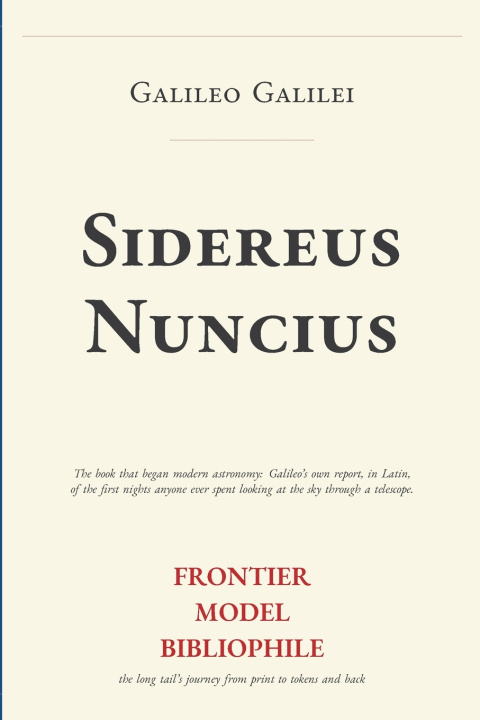
Sidereus Nuncius
 Angleščina
 38 b
38 b
 Kmalu
Kmalu
 Novo
Novo
 Izdaje 06. 07. 2027
Do 30 dni za vračilo

In March 1610 Galileo Galilei published the first record of the heavens seen through a telescope: mountains on the Moon, the Milky Way resolved into stars, and four moons circling Jupiter - the Medicean Stars - whose plain revolution undercut the Earth-centered cosmos. This edition reproduces the 1610 Latin first edition in facsimile, preserved and untranslated, with editorial apparatus that sets Galileo's discoveries, and their long consequence, in their place.
The Sidereus Nuncius appeared in March 1610, printed at Venice by Tomaso Baglioni, and it is best understood as the report of an instrument as much as of a man. In the summer of 1609 word reached Italy of a Dutch device that made distant objects appear near. Galileo, then professor of mathematics at Padua, grasped the optical principle at once and set about improving the instrument. Where the first spyglasses magnified perhaps three times, Galileo ground and arranged his lenses to reach eight, then twenty, then roughly thirty times magnification - an instrument good enough to turn from terrestrial use, where it had obvious military and commercial value, to the night sky. He called it a perspicillum. No one before had systematically examined the heavens through such a glass, and the sky it revealed contradicted the settled learning of two thousand years.
The first of his discoveries concerned the Moon. To Aristotelian philosophy the heavenly bodies were perfect, changeless spheres of a substance unlike anything on Earth, and the Moon's mottled face was explained as a difference of density in a flawless globe. Through the telescope Galileo saw something else entirely: a broken, mountainous landscape of bright peaks and dark hollows, with the line dividing light from shadow advancing raggedly across it as the sunlight does over the ranges of the Earth. He saw points of light catch the dawn beyond the terminator, as mountaintops catch the sun before the valleys, and from the lengths of the shadows he even estimated the heights of the lunar mountains. The Moon, he concluded, was a world like our own - rough, solid, and sunlit - not a perfect celestial orb. His woodcut diagrams of the lunar surface, reproduced in this facsimile, were the first attempt to draw the Moon as it actually looks through a telescope.
His second discovery concerned the fixed stars and the Milky Way. The telescope showed many more stars than the unaided eye can see, and resolved the soft luminous band of the Milky Way - long a puzzle - into a dense multitude of individual stars too faint and too closely set to be told apart without the glass. The nebulous patches scattered through the sky proved, likewise, to be clusters of stars. The heavens were far more populous than anyone had supposed, and their populousness was a matter of plain observation, not speculation.
The third discovery was the most consequential. On the nights of January 1610 Galileo noticed three, and then four, small bright stars ranged in a line near Jupiter. Watching them from night to night, he saw that they changed position with respect to the planet and to one another, sometimes passing behind or before it, always staying close - and he understood that they were not fixed stars at all but moons, four bodies circling Jupiter as the Moon circles the Earth. He recorded their nightly configurations in the printed sequence of diagrams that fills the latter part of the book, and he named them the Medicean Stars in honor of Cosimo II de' Medici, Grand Duke of Tuscany, whose patronage he was then seeking and soon won. (Later astronomy would call them the Galilean moons - Io, Europa, Ganymede, and Callisto.)
The Copernican implication of this last discovery was its real charge.


O knjigi
Angleščina

Podarite to knjigo še danes
To je povsem preprosto
1 Dodajte knjigo v košarico in izberite dostavo kot darilo 2 V zameno vam bomo poslali kupon 3 Knjiga bo dostavljena na naslov obdarovancaPozdravljeni! Sem Libroamiko, vaš knjižni svetovalec.
Kako vam lahko pomagam?