
 Kontakt
 Kako nakupovati
Dostava
Svetovalec pri nakupu
 Angleščina
 78 b
78 b
 Novo
Novo
30 dni za vračilo blaga

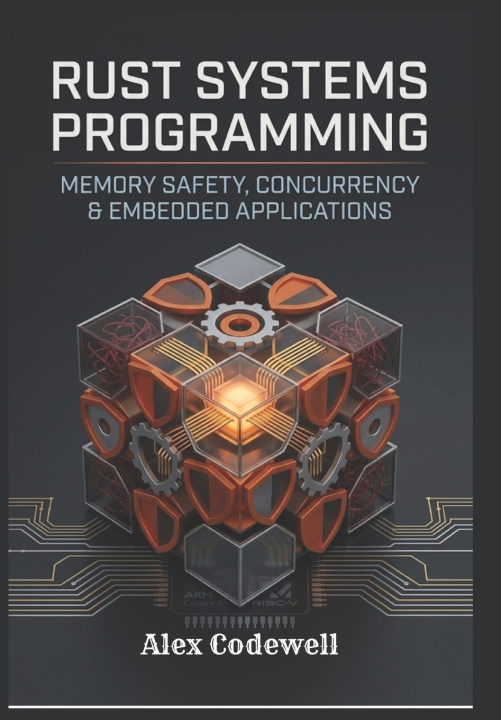
Rust Systems Programming: Memory Safety, Concurrency & Embedded Applications.
What if the compiler could catch the memory errors that cost the industry billions-before a single line of your code reached production?
Rust is not merely another systems language. It is a paradigm shift that rejects the false choice between safety and speed. This book is written for the engineer who has shipped production C but lies awake thinking about that unchecked pointer; for the firmware developer exhausted by vendor lock-in; for the architect choosing the language that will define the next decade of infrastructure. Spanning bare-metal ARM Cortex-M and RISC-V microcontrollers to high-performance concurrent servers, the text organizes its guidance into five progressive parts-ownership semantics, fearless concurrency, controlled unsafe, embedded architecture, and production-grade deployment.
Inside, you will find:
• How Rust's borrow checker functions as a formal verification system-enforcing, at compile time, the memory discipline that expert C programmers spend careers internalizing
• Why zero-cost abstractions and deterministic resource management position Rust to break the embedded expertise bottleneck without sacrificing real-time guarantees
• How to build a memory-safe device driver that uses Rust's type system to enforce correct state transitions at compile time
• The architectural patterns behind a lock-free real-time data acquisition system, a minimal TCP/IP stack with zero-copy networking, and an async runtime built for resource-constrained environments
• A rigorous treatment of unsafe as a controlled interface-not a forbidden zone-plus deterministic testing, secure boot, and over-the-air update strategies for production firmware
If you believe segfaults are not an inevitable tax on systems programming, this book provides the architectural depth and production-grade examples to prove it. Stop trusting human discipline alone to manage memory. Start writing systems that are fast by design and safe by construction-from bare-metal microcontrollers to concurrent servers. The tools have changed. Your code should too.


O knjigi
Angleščina
