
 Kontakt
 Kako nakupovati
Dostava
Svetovalec pri nakupu
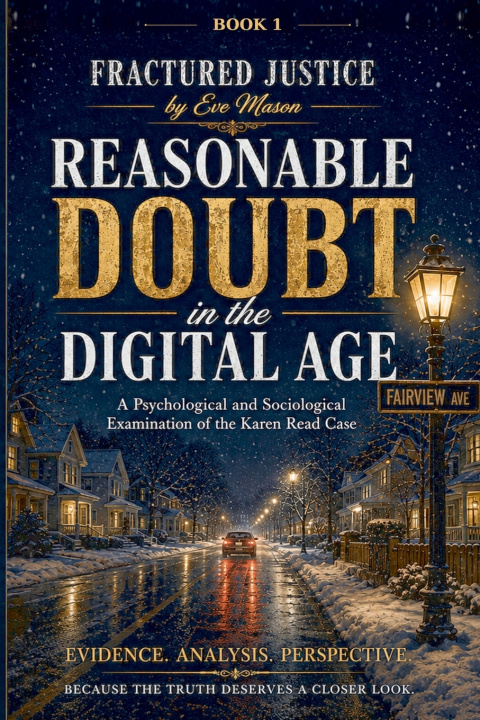
Reasonable Doubt in the Digital Age
A Psychological and Sociological Examination of the Karen Read Case
 Angleščina
 25 b
25 b
 Novo
Novo
Do 30 dni za vračilo

What happens when a criminal case unfolds not only in a courtroom, but across social media, livestreams, podcasts, news coverage, and millions of online conversations?
In Reasonable Doubt in the Digital Age, Eve Mason examines the Karen Read case through a psychological and sociological lens, exploring how evidence, media coverage, digital communities, and public belief can shape the way people understand guilt, innocence, and reasonable doubt.
The death of Boston police officer John O'Keefe and the prosecution of Karen Read became far more than a criminal case. Competing narratives emerged almost immediately. Supporters, critics, journalists, attorneys, experts, and online creators interpreted the same evidence in dramatically different ways. As the case gained national attention, the courtroom and the internet began operating as two very different arenas of judgment.
This book asks a central question: how does reasonable doubt form when the public is exposed to far more information than a jury is ever permitted to consider?
Through accessible analysis of psychology, sociology, media influence, and the justice system, Mason explores:
• how confirmation bias and cognitive dissonance affect the way people interpret evidence
• why repeated claims can begin to feel true even when their origins are uncertain
• how social media can intensify group identity and polarization
• the difference between evidence presented in court and information circulating online
• how expert disagreement can create or deepen reasonable doubt
• the influence of true crime media, commentary, and digital communities
• why people can examine the same facts and reach completely different conclusions
• how public confidence in law enforcement, prosecutors, defense attorneys, and institutions affects perceptions of a case
Reasonable Doubt in the Digital Age does not ask readers to join a side. It asks them to examine how they reached their conclusions.
Using the Karen Read case as a real-world framework, this first volume of the Fractured Justice series looks beyond the question of guilt or innocence and examines something broader: how modern audiences process evidence, uncertainty, competing narratives, and institutional trust in an age when everyone with a phone can participate in the public trial.
For readers interested in the Karen Read case, John O'Keefe, reasonable doubt, true crime, trial psychology, digital evidence, social media influence, criminal justice, and public opinion, this book offers a thoughtful examination of how justice is experienced in the digital age.
Evidence. Analysis. Perspective. Because the truth deserves a closer look.


O knjigi
Angleščina

Podarite to knjigo še danes
To je povsem preprosto
1 Dodajte knjigo v košarico in izberite dostavo kot darilo 2 V zameno vam bomo poslali kupon 3 Knjiga bo dostavljena na naslov obdarovancaPozdravljeni! Sem Libroamiko, vaš knjižni svetovalec.
Kako vam lahko pomagam?