
 Kontakt
 Kako nakupovati
Dostava
Svetovalec pri nakupu
 Angleščina
 68 b
68 b
 Novo
Novo
30 dni za vračilo blaga

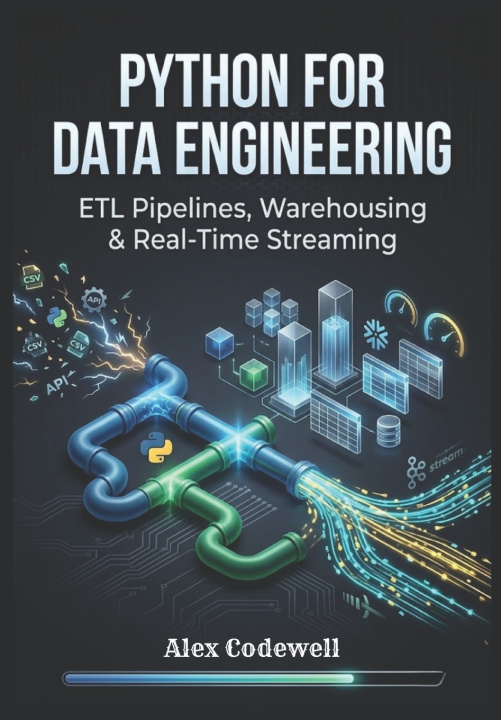
What separates data pipelines that survive Friday night deployments from those that collapse before Monday morning?
Most Python developers can write scripts that process CSV files. Few can build systems that handle API timeouts, schema drift, and that 2 AM alert when the CFO's dashboard shows $40,000 in missing revenue. This book bridges that gap with fifteen years of battle-tested engineering wisdom drawn from hedge funds, health-tech startups, and Fortune 500 retailers.
Inside, you will learn how to:
• Build ETL pipelines that fail predictably, recover automatically, and alert meaningfully-before stakeholders notice
• Design warehouse schemas that handle real-world data quality issues without requiring midnight refactoring
• Implement real-time streaming with Kafka and Python that survives Unicode exceptions and rate-limit storms
• Apply testing strategies and type safety that prevent the 3 AM debugging sessions every data engineer dreads
• Control costs and observability across cloud infrastructure so your pipelines outlast your tenure
Every pattern here has been tested against actual latency requirements, budget constraints, and stakeholders who change specifications mid-quarter. The code is complete, runnable, and intentionally imperfect-showing the retry logic, workarounds, and memory optimizations that production demands.
Data engineering is not about elegant syntax. It is about writing defensible systems that handle upstream failures, downstream schema changes, and the inevitable moment when someone uploads the wrong file at the worst possible time.
If you are ready to move from writing scripts to owning infrastructure that powers business decisions, this manual gives you the frameworks, failure patterns, and operational rigor to do exactly that. Your pipelines will not just run. They will endure.
Get your copy today and build data systems that last-starting with your very next deployment.


O knjigi
Angleščina
