
 Kontakt
 Kako nakupovati
Dostava
Svetovalec pri nakupu
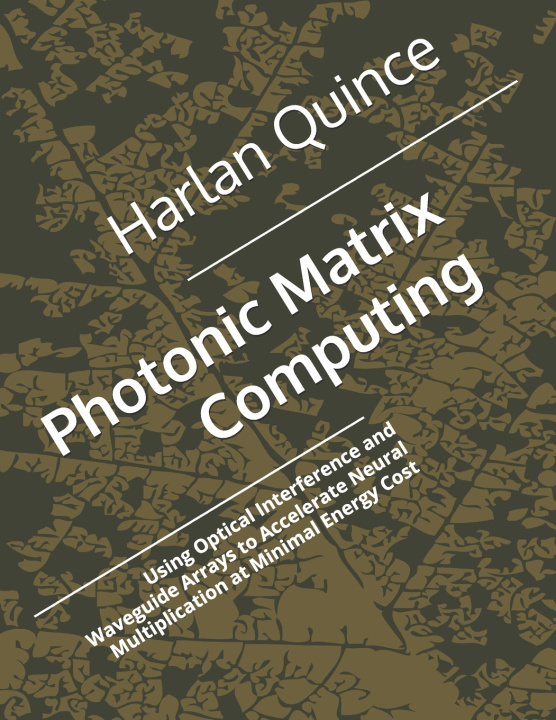
Photonic Matrix Computing
Using Optical Interference and Waveguide Arrays to Accelerate Neural Multiplication at Minimal Energy Cost
 Angleščina
 42 b
42 b
 Kmalu
Kmalu
 Novo
Novo
30 dni za vračilo blaga

Photonic matrix computing for modern neural workloads
This book presents a practical, system-level view of how optical interference, coherent light, and programmable waveguide arrays can be used to perform matrix multiplication with far less energy than conventional digital MAC pipelines. It bridges core physics, hardware design, and neural network deployment, making it useful for readers who want to understand both the promise and the engineering limits of photonic acceleration.
Beginning with the computational role of matrix operations in neural networks, the book explains how dataflow, numerical formats, and matrix shapes influence hardware efficiency. It then builds the optical foundation, covering coherence, phase control, intensity detection, and the linear behavior that makes photonic transforms possible.
From there, the focus shifts to real architectures, including reconfigurable photonic meshes, beam splitters, phase shifters, and calibration methods for realizing target matrices. Detailed coverage shows how to encode inputs, handle positive and negative values, scale outputs, and run batch or tiled workloads for larger layers.
- Hardware-aware training and inference for optical weight constraints
- Nonidealities and mitigation including loss, crosstalk, quantization, and detector noise
- Energy accounting across optical power, modulation, control, I/O, and synchronization
- Integration strategies for combining photonic tiles with digital systems
- Calibration, verification, and maintenance workflows for stable operation
The later chapters bring these ideas together through case studies and design methodology, showing how to estimate energy budgets, choose encodings, and co-design accuracy with power consumption. Worked examples throughout the book make the material concrete and help readers move from theory to implementation.
Ideal for engineers, researchers, and advanced students working in photonics, hardware acceleration, and efficient neural computation.


O knjigi
Angleščina

Podarite to knjigo še danes
To je povsem preprosto
1 Dodajte knjigo v košarico in izberite dostavo kot darilo 2 V zameno vam bomo poslali kupon 3 Knjiga bo dostavljena na naslov obdarovancaPozdravljeni! Sem Libroamiko, vaš knjižni svetovalec.
Kako vam lahko pomagam?