
 Kontakt
 Kako nakupovati
Dostava
Svetovalec pri nakupu
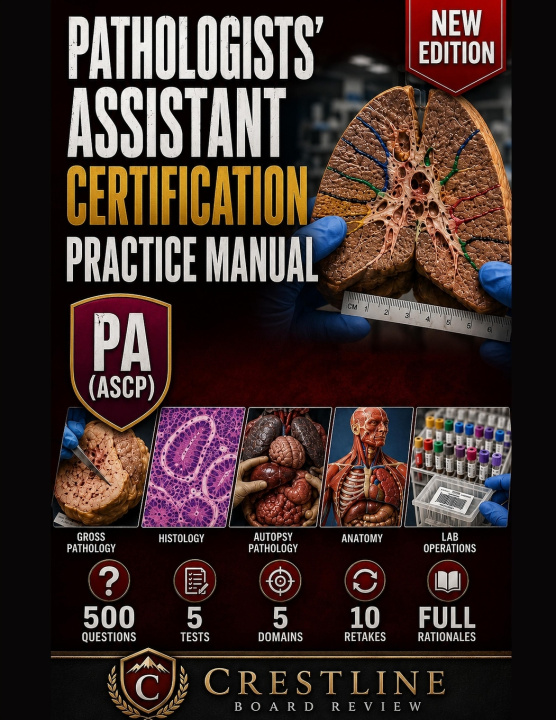
Pathologists' Assistant Certification Practice Manual
Five Teaching-First 100-Question PA(ASCP) Practice Tests with Blueprint Reviews, Scenario Rationales, Retake Packs, and Final Review Tools
 Angleščina
 108 b
108 b
 Kmalu
Kmalu
 Novo
Novo
Do 30 dni za vračilo

Prepare for PA(ASCP) Certification With Applied Pathology Decisions
The Pathologists' Assistant examination is broad by design. You must connect disease mechanisms, gross and microscopic findings, specimen handling, anatomy, autopsy context, safety, and laboratory operations-then choose one best answer under a 150-minute clock. This manual turns that range into a repeatable practice system.
Five Teaching-First 100-Question Practice Tests
Work through five original, fixed-form tests built around the PA(ASCP) content areas. Each test is divided into four 25-question blocks with a target of about 37 minutes per block. The progression moves from core pathology recognition to grossing and histology workflow, applied specimen scenarios, difficult exceptions, and final full-domain integration.
600 Original Questions and Scenario Rationales
Five main tests and two fresh retake packs in each practice-test chapter yield 600 questions total. Every rationale identifies the correct answer, explains the governing pathology or workflow rule, eliminates the distractors, names the pitfall, flags an exam look-out, and closes with a compact rule to carry into later questions.
Use the Spot, Decide, Verify Method
Spot the tested domain and the real task: pathology mechanism, technique selection, anatomy, autopsy priority, or operations control. Decide from the governing rule, not the most familiar phrase. Verify the answer against the controlling details-organ, specimen type, orientation, margin, age, morphology, authorization, safety risk, or documentation status.
Practice the Full PA(ASCP) Content Mix
Review Fundamentals of Pathology, Anatomic Pathology Techniques, Anatomy, Autopsy Pathology, and Laboratory Operations. Questions cover cell injury, hemodynamic change, immunopathology, infection, neoplasia, systemic pathology, grossing, fixation, histology, frozen sections, decalcification, normal anatomy, adult and perinatal autopsy, medicolegal handling, accreditation, coding, personnel, workflow, and infection control.
Turn Every Score Into a Repair Plan
After each 100-question test, use the Domain Mastery Dashboard and Competency Heatmap to locate the actual weak area. Separate a morphology gap from a task error, sequence error, anatomy error, verification miss, or unsafe operations shortcut. Green, yellow, and red guidance tells you when to maintain, review, retake, or rebuild a core concept before moving forward.
Retest Weak Areas With Fresh Scenarios
Retake Pack A repairs broad recognition, process, and domain weakness. Retake Pack B targets near misses, boundary conditions, specimen-state limits, anatomy relationships, medicolegal details, and quality controls. The new scenarios force transfer. A higher score means you applied the rule to different evidence, not that you remembered the previous stem.
Finish With a Focused Final Review Command Center
Chapter 8 compresses the book into domain weights, scope boundaries, high-frequency rules, anatomy and autopsy indexes, laboratory operations look-outs, acronyms, glossary terms, and final 48-hour guidance. Use the fast-track or 30-day study plan, keep an external error log, review every rationale, and protect the decision habits that still work after 80 questions. Visual aids reinforce blueprint weighting, timing checkpoints, specimen workflow, quality control, clue hierarchy, ancillary-test triage, and final answer filtering. Completed examples show how orientation, margins, tissue state, control failure, and chain of custody change the safest next action now. This independent manual does not reproduce live questions or adaptive scoring; it gives you stable, blueprint-based practice designed for study, review, and remediation.


O knjigi
Angleščina

Podarite to knjigo še danes
To je povsem preprosto
1 Dodajte knjigo v košarico in izberite dostavo kot darilo 2 V zameno vam bomo poslali kupon 3 Knjiga bo dostavljena na naslov obdarovancaPozdravljeni! Sem Libroamiko, vaš knjižni svetovalec.
Kako vam lahko pomagam?