
 Kontakt
 Kako nakupovati
Dostava
Svetovalec pri nakupu
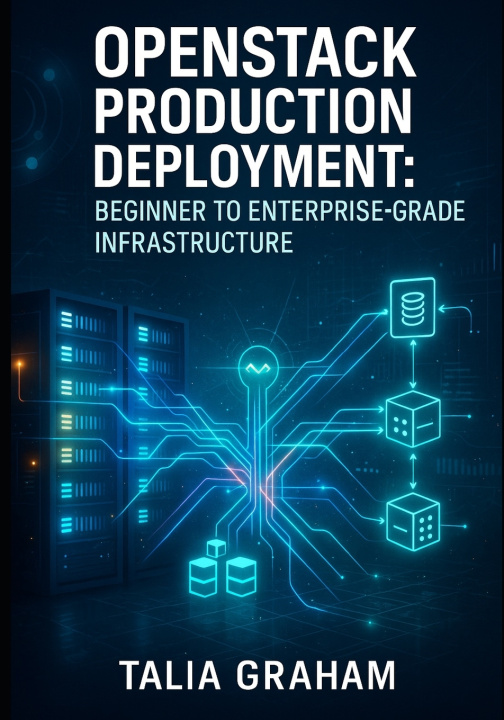
OPENSTACK PRODUCTION DEPLOYMENT
BEGINNER TO ENTERPRISE-GRADE INFRASTRUCTURE: Master HA, Security, Automation & Multi-Region Architecture Step-by-Step
 Angleščina
 65 b
65 b
30 dni za vračilo blaga

Build and run OpenStack like a reliable production platform, from first host to multi-region operations.
Most OpenStack books stop at lab deployments. Real environments demand high availability, security you can audit, storage that survives failures, clean networking, and upgrades that do not interrupt users. This book shows how to design, deploy, and operate OpenStack with practices that hold up under pressure.
You will work through a full stack built with Kayobe and Kolla Ansible, containers on bare metal, Neutron with OVN, Ceph backed storage, and Octavia for load balancing. Each step is grounded in clear configurations, repeatable automation, and operational checks that keep the platform healthy.
- Design a production baseline using Kayobe for host lifecycle and Kolla Ansible for services
- Build a resilient control plane with HAProxy, Keepalived VIPs, Galera, RabbitMQ quorum queues, and a secure cache layer
- Use Neutron ML2 with OVN, Geneve overlays, routed provider networks, L3 HA, OVN BGP agent, and OVSDB RAFT with relays
- Deploy Octavia with OVN provider or Amphora and run clean ingress patterns, tenant self service, and anycast or blue green VIPs
- Run Ceph for OpenStack, plan CRUSH and pools, use RBD for Nova Cinder Glance, enable multistore, and add Manila with CephFS
- Plan Nova at scale with Cells v2, placement, flavor policy, CPU pinning, NUMA, huge pages, SR IOV, DPDK, and TLS live migration on RBD
- Create images with cloud init, qemu guest agent, virtio best practices, and build pipelines with Packer or Diskimage builder
- Monitor with Prometheus exporters and alerts across API DB MQ OVN Octavia and track SLOs with the Grafana dashboards that matter
- Ship logs with Fluentd to OpenSearch or Elasticsearch with retention tiers and run capacity modeling driven by placement
- Operate multi region and edge with Keystone regions and endpoint filtering, Glance multistore single UUID, and Designate split horizon DNS
- Upgrade safely with rolling Kolla Ansible workflows, prechecks, canaries, and OVS to OVN migration plans with MTU and DHCP audits
- Practice recovery with backups to RGW, RBD mirroring, restore drills, and incident runbooks that shorten time to resolution
- Automate day two with OpenStackSDK patterns, the Ansible openstack cloud collection, and the Terraform provider for tenant facing IaC
- Validate continuously with Tempest smoke gates, fault injection drills, OVN tracing, SB statistics, and relay health checks
This is a code heavy guide. Working configurations and scripts are presented with clear labels so you can adapt them to real clusters quickly.
Get the practical OpenStack playbook operators use in production, and put it to work today.


O knjigi
Angleščina
