
 Kontakt
 Kako nakupovati

Dostava
Svetovalec pri nakupu
 Angleščina
 35 b
 Novo
 Bo dostavljeno do božiča ▾
Na zalogi pri dobavitelju
Odposlali bomo v 9-13 dneh
Do 30 dni za vračilo

Was Friedrich Nietzsche a political philosopher? And what did he mean by the politics of the future?
Nietzsche's writings on politics resist every convenient classification. He was a severe critic of nationalism, mass conformity, parliamentary democracy, socialism, and the modern state. Yet his reflections on aristocracy, slavery, hierarchy, cultural formation, and the government of the earth raise some of the most disturbing questions in modern political philosophy. His rejection of political orthodoxies did not amount to a simple defense of individual liberty; nor can his conception of great politics be reduced to the ambitions of the nation-state.
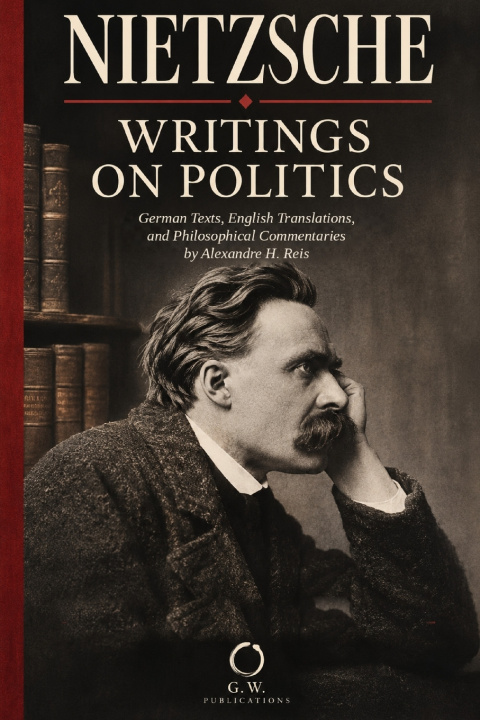
Nietzsche: Writings on Politics brings together a substantial selection of Friedrich Nietzsche's political writings from his published works, posthumous notebooks, and correspondence, presenting German texts, English translations, and philosophical commentaries by Alexandre H. Reis.
The collection follows the development of Nietzsche's political thought from his early reflections on Greek culture, education, the state, and the conditions of artistic greatness to his mature investigations of morality, punishment, democratic modernity, European identity, and the historical possibilities of great politics. Particular attention is given to the posthumous fragments, where Nietzsche's reflections on political authority, social hierarchy, world economy, and the future organization of humanity assume their most provocative formulations.
Rather than imposing a coherent political doctrine upon a deliberately unsystematic thinker, Reis examines the tensions that run through Nietzsche's philosophy. How can the denunciation of nationalism coexist with an uncompromising defense of rank? What becomes of political freedom when culture is understood as inseparable from relations of power? Can Nietzsche's critique of democratic equality be distinguished from authoritarian politics without concealing the severity of his own formulations? And how should we understand the relationship between the liberation of the individual, the formation of values, and the political ambition to shape humanity's future?
The commentaries place these questions within Nietzsche's intellectual development, attending to the differences between published arguments, experimental notebook formulations, and the rhetorical strategies of his philosophical writing. They also explore the relationship between political authority and the valuation of life, extending a line of inquiry developed in Reis's companion volume, Nietzsche: Writings on Suicide.
Designed for philosophers, scholars, graduate students, and serious readers of Nietzsche, this edition offers a sustained encounter with the political dimensions of his thought. It neither domesticates Nietzsche into a liberal theorist nor assimilates him uncritically to the authoritarian movements that later appropriated his language.
At stake is a question that reaches beyond Nietzsche's historical moment: who has the authority to determine the values, institutions, and forms of life through which humanity understands and governs itself?


O knjigi
Angleščina
Kategorije

Podarite to knjigo še danes
To je povsem preprosto
1 Dodajte knjigo v košarico in izberite dostavo kot darilo 2 V zameno vam bomo poslali kupon 3 Knjiga bo dostavljena na naslov obdarovancaPozdravljeni! Sem Libroamiko, vaš knjižni svetovalec.
Kako vam lahko pomagam?