
 Kontakt
 Kako nakupovati
Dostava
Svetovalec pri nakupu
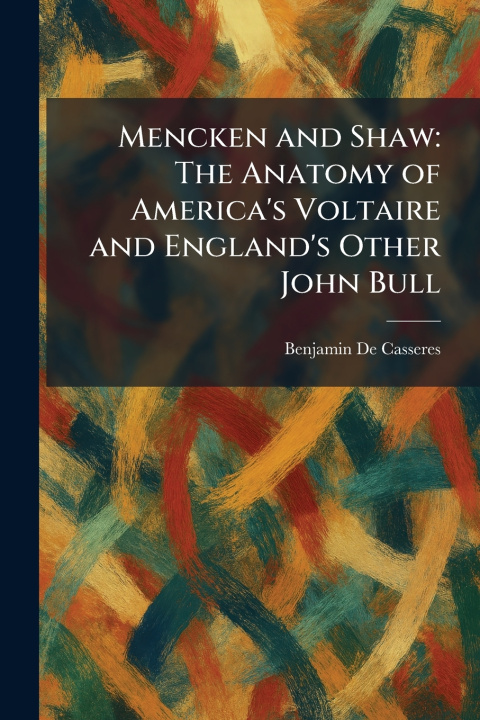
Mencken and Shaw
The Anatomy of America's Voltaire and England's Other John Bull
 Angleščina
 45 b
45 b
Do 30 dni za vračilo

In "Mencken and Shaw: The Anatomy of America's Voltaire and England's Other John Bull", Benjamin De Casseres presents a provocative and insightful comparative study of two of the most influential cultural critics of the early twentieth century: H.L. Mencken and George Bernard Shaw. De Casseres, himself a noted iconoclast, explores the intellectual parallels and striking contrasts between the "Sage of Baltimore" and the master of "Shavian" wit. By characterizing Mencken as an American Voltaire and Shaw as a modern John Bull, the author delves into their shared penchant for dismantling social hypocrisy, their unique styles of satire, and their profound impact on the literary and philosophical landscapes of their respective nations.
This work serves as a vibrant examination of individualistic thought and social critique during a transformative era. De Casseres analyzes how both men wielded language as a weapon against mediocrity and dogma, shaping the public discourse of the 1920s and 1930s. "Mencken and Shaw" is an essential read for those interested in the history of literary criticism, the evolution of modern satire, and the enduring legacy of two giants of letters who dared to challenge the status quo.
This work has been selected by scholars as being culturally important, and is part of the knowledge base of civilization as we know it. This work was reproduced from the original artifact, and remains as true to the original work as possible. Therefore, you may see the original copyright references, library stamps (as most of these works have been housed in our most important libraries around the world), and other notations in the work.
This work is in the public domain in the United States of America, and possibly other nations. Within the United States, you may freely copy and distribute this work, as no entity (individual or corporate) has a copyright on the body of the work.
As a reproduction of a historical artifact, this work may contain missing or blurred pages, poor pictures, errant marks, etc. Scholars believe, and we concur, that this work is important enough to be preserved, reproduced, and made generally available to the public. We appreciate your support of the preservation process, and thank you for being an important part of keeping this knowledge alive and relevant.


O knjigi
Angleščina
