
 Kontakt
 Kako nakupovati
Dostava
Svetovalec pri nakupu
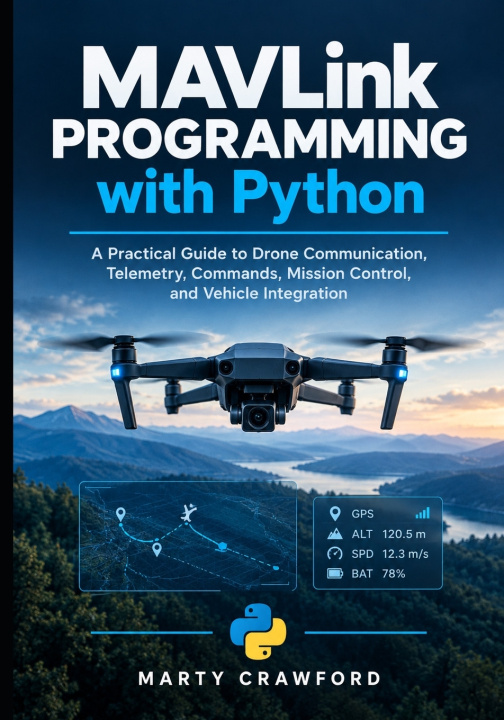
MAVLink Programming with Python
A Practical Guide to Drone Communication, Telemetry, Commands, Mission Control, and Vehicle Integration
 Angleščina
 44 b
44 b
 Novo
Novo
Do 30 dni za vračilo

MAVLink provides a communication layer through which UAV software can exchange information with flight controllers, companion computers, ground stations, and other components. For Python developers, understanding MAVLink opens the door to building applications that can monitor vehicles, process telemetry, send commands, manage missions, and integrate software with UAV systems.
MAVLink Programming with Python takes a focused, developer-oriented approach to building Python applications around MAVLink communication. While the first book in the series introduces UAV programming broadly, this book goes deeper into the communication, command, telemetry, mission, and integration concepts that developers encounter when building more capable UAV software.
The book begins by establishing a strong understanding of MAVLink architecture. Readers learn about systems, components, messages, commands, events, identifiers, communication models, and compatibility considerations. These concepts provide the foundation for understanding what happens between a Python application and a connected UAV.
From there, the book moves into practical Python development. Readers explore development environments, MAVLink libraries and tools, serial connections, network connections, connection management, and reusable communication layers. The goal is to help developers move beyond one-off scripts and toward better-organized UAV applications.
Telemetry is another central subject. The book explains how Python applications can receive, filter, process, and store information about vehicle position, attitude, navigation, battery state, and overall system status. Readers also learn how telemetry can become part of a broader data-processing and monitoring pipeline.
The book then explores MAVLink commands and vehicle control. Readers examine command identifiers, parameters, acknowledgments, flight modes, arming commands, navigation commands, and command sequencing. Particular attention is given to reliable communication and handling situations where commands fail, time out, or produce unexpected responses.
Mission programming receives dedicated treatment as well. Readers learn about the MAVLink mission protocol, mission items, waypoints, mission creation, mission uploads and downloads, mission monitoring, and dynamic mission management. These concepts provide a foundation for developing software capable of interacting with automated flight missions.
Beyond individual messages and commands, the book addresses vehicle integration. Readers explore flight-controller communication, companion computers, ground control systems, multiple MAVLinkcomponents, system identification, and applications that need to manage different parts of a UAV software architecture.
Inside the book, readers will explore:
• MAVLink architecture and communication concepts• Python MAVLink development environments
• Serial and network connections
• MAVLink messages and message fields
• Heartbeats, telemetry, and system status
• Commands, parameters, and acknowledgments
• Vehicle state and flight-control communication
• MAVLink mission programming
• Waypoints and mission management
• Telemetry processing and data logging
• Vehicle and flight-controller integration
• Companion computer communication
• MAVLink events and configuration
• Asynchronous and event-driven programming
• Communication timeouts and recovery
• Simulation and MAVLink testing
• Debugging and inspecting MAVLink traffic
• Designing reusable Python MAVLink applications
Designed for developers who want to understand what happens beneath higher-level drone APIs, MAVLinkProgramming with Python provides a practical foundation for working directly with UAV communication and building software that can interact with increasingly sophisticated vehicle systems.


O knjigi
Angleščina

Podarite to knjigo še danes
To je povsem preprosto
1 Dodajte knjigo v košarico in izberite dostavo kot darilo 2 V zameno vam bomo poslali kupon 3 Knjiga bo dostavljena na naslov obdarovancaPozdravljeni! Sem Libroamiko, vaš knjižni svetovalec.
Kako vam lahko pomagam?