
 Kontakt
 Kako nakupovati
Dostava
Svetovalec pri nakupu
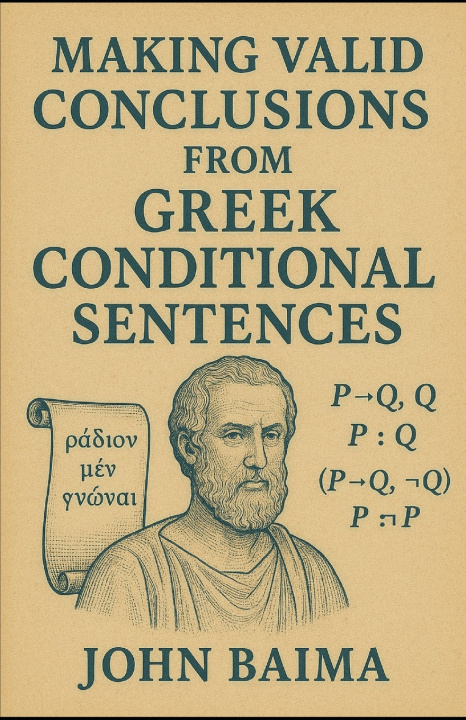
Making Valid Conclusions from Greek Conditional Sentences
 Angleščina
 34 b
34 b
Do 30 dni za vračilo

For any conditional sentence of the type If . . . then . . . there are two ways of making an inference from the sentence. First, if the protasis is true, then the apodosis must be true. Second, if the apodosis is false, then the protasis must be false. In any given conditional sentence, the author only intends the listener to use one of these inference rules to come to the intended conclusion (it is possible that on rare occasions that the author intends for both inference rule to be used). There are sentences in the New Testament which use the second inference rule.
The grammars have not explored the possibility of applying the second inference rule to Greek conditional sentences and have therefore misunderstood and improperly described some texts. The most common places where this second inference rule is found are in Second Class Conditions and conditions with an imperative in the apodosis.
Another sentence type of logic is the if and only if sentence. It is unclear if these sentences occur in the New Testament. Two possible constructions are conditional sentences which use εἴπερ and conditional sentences which use εἴ γε. It is possible that there are other surface structures which are intended to communicate the same semantic field. The significance of these sentences is that if it is known what either the protasis or apodosis is, then the other half of the conditional sentence must have the same truth condition.
One last application of logic is that for every conditional sentence, there exists another which is logically equivalent. This transformation may be helpful in translation. One such possible example is when translating into English and the conditional sentence has a negative in both the protasis and the apodosis.


O knjigi
Angleščina

Podarite to knjigo še danes
To je povsem preprosto
1 Dodajte knjigo v košarico in izberite dostavo kot darilo 2 V zameno vam bomo poslali kupon 3 Knjiga bo dostavljena na naslov obdarovancaPozdravljeni! Sem Libroamiko, vaš knjižni svetovalec.
Kako vam lahko pomagam?