Brezplačna dostava za naročila nad 69,99 € na prevzemna mesta DPD in Express One.

Postanite del skupnosti ljubiteljev knjig z vsega sveta in uživajte v številnih ugodnostih.
Ustvarite brezplačen račun
Brezplačna dostava Zásilkovna nad 69.99 €
Zbirna točka GLS 4.49 €
Zbirna točka DPD 2.99 €
Kurirska služba GLS 5.49 €
Kurir DPD 3.49 €
Kurirska služba Express One 3.49 €
Zbirno mesto Express One 3.49 €
Zbirno mesto Pošte Slovenije 3.49 €
Dostava preko Pošte Slovenije 3.49 €
 Kontakt
 Kako nakupovati

Pomoč
Dostava
Zbirna točka GLS 4.49 €
Zbirna točka DPD 2.99 €
Kurirska služba GLS 5.49 €
Kurir DPD 3.49 €
Kurirska služba Express One 3.49 €
Zbirno mesto Express One 3.49 €
Zbirno mesto Pošte Slovenije 3.49 €
Dostava preko Pošte Slovenije 3.49 €
Brezplačna dostava Zásilkovna nad 69.99 €
Svetovalec pri nakupu
Moj račun
▸
Prazna :-(
0
Brezplačna dostava za naročila nad 69,99 € na prevzemna mesta DPD in Express One.
Macrame Bracelets and Necklaces Made Easy
Square, Spiral and Lark's Head Ties in Waxed Cord for Wrists, Throats and Lobes, with Bead Placement and Length Tables
Jezik
 Angleščina
Knjiga
Mehka
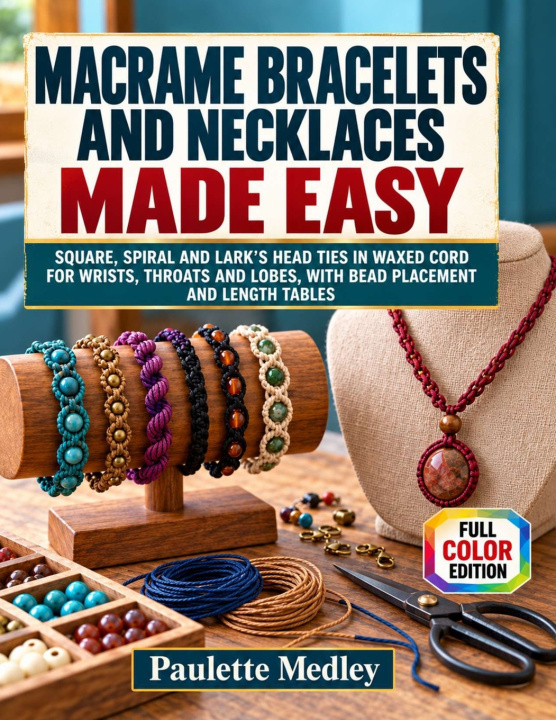
The bracelet is finished and every knot is tight, but it will not go over your hand. Or it slips rig...
Celoten opis
Koda Libristo: 54316789
?
 62 b
 Novo
62 b
Novo
25.63
€
Na zalogi pri dobavitelju
Odposlali bomo v 9-13 dneh
Do 30 dni za vračilo

The bracelet is finished and every knot is tight, but it will not go over your hand. Or it slips right off the wrist, because the cord was cut long before anyone measured anything.
Most knotted jewelry goes wrong before the first knot. The cord is cut by eye, a bead turns out to have a hole too narrow for two strands, and a choker runs out of cord two inches short of the clasp, though the knots themselves were fine. What failed was the arithmetic at the spool, the part most patterns skip and no amount of careful knotting can repair afterward.
Twenty-Four Patterns on Three Ties
- Sliding-closure and clasp bracelets in square knots, from a slim 1.0 mm band that opens to a 9 in loop to a chunky 2.0 mm cuff on a larger clasp
- Spiral bracelets and cuffs, including a twist that reverses partway along and a double-wrap bracelet worked as 96 half knots on one long cord
- Fringe bracelets in two colors, one strung with 8 mm glass beads that hang from doubled strands at two staggered heights on a sliding closure
- Beaded bracelets that mix knots, from one 6 mm center bead to a bracelet that combines all three ties on one cord
- Three chokers cut to the neck: a 16 in square knot choker, an adjustable spiral choker that opens to 26 in, and a five-bead choker on a clasp
- Pendants and necklaces: a stone pendant hung from a spiral cord that slides to fit, and seven beads spaced along a 20 in matinee strand on a clasp
- Square knot, spiral twist, and tassel earrings for the lobe, each written as a matched pair, from a 1 in knotted run to a 3 in tassel
Each design begins with a measurement and ends with a count you can check against a ruler, and every planning figure in the tables comes with a short test strip that shows whether it holds for your cord and your hands, since cord size and tension change every number.
Length Tables and Bead Rules
- Cord length tables for sliding and clasp bracelets, chokers, and necklaces, with the 4-to-1 working cord rule explained and checked
- A ten-knot test strip that measures your own gauge, so each table scales to your particular cord, your tension, and your hands
- Bead placement rules: hole size by number of cords, then knot counts between beads for layouts that read the same from both ends
- Measuring steps for wrist, hand, neck, and head, drawn from published body data, with fit tables and standard necklace lengths
- Materials and tools guidance, from waxed polyester cord and gemstones with holes wide enough for two cords to nickel-free ear wires
Knotting techniques for jewelry are taught here from the cord up: the lark's head that mounts every piece, then the square knot, then the half-knot spiral, and only then the patterns, each with numbered step by step instructions.
Every pattern names the ties it uses, so a slim slider bracelet of fifteen knots suits a first project for beginners and the three-tie bracelet can wait.
Fringe and tassels join only where a pattern calls for them, and stone or glass beads follow the same rule, with the cord planned ahead.
This is the book that lives beside the spool and the tape measure.
Igralka
&
Poliglotka
EWA KASP
za
Predvajaj video


Libristo ima največjo izbiro tujejezične literature. Zato svoje knjige kupujem tukaj.
O knjigi
Polni naslov
Macrame Bracelets and Necklaces Made Easy
Avtor
Paulette Medley
Jezik
Angleščina
Angleščina
Vezava
Knjiga - Mehka
Datum izida
2026
Število strani
160
EAN
9798165798894
Koda Libristo
54316789
Založba
Independently published
Teža
388
Mere
216 x 280 x 9

Podarite to knjigo še danes
To je povsem preprosto
1 Dodajte knjigo v košarico in izberite dostavo kot darilo 2 V zameno vam bomo poslali kupon 3 Knjiga bo dostavljena na naslov obdarovanca
Knjižni svetovalec Libroamiko
Z uporabo tega klepeta komunicirate z generativno umetno inteligenco. Z njegovo uporabo se strinjate tudi z obdelavo osebnih podatkov.
Pozdravljeni! Sem Libroamiko, vaš knjižni svetovalec.
Kako vam lahko pomagam?
Pozdravljeni, sem Libroamiko, vam lahko pomagam?