
 Kontakt
 Kako nakupovati
Dostava
Svetovalec pri nakupu
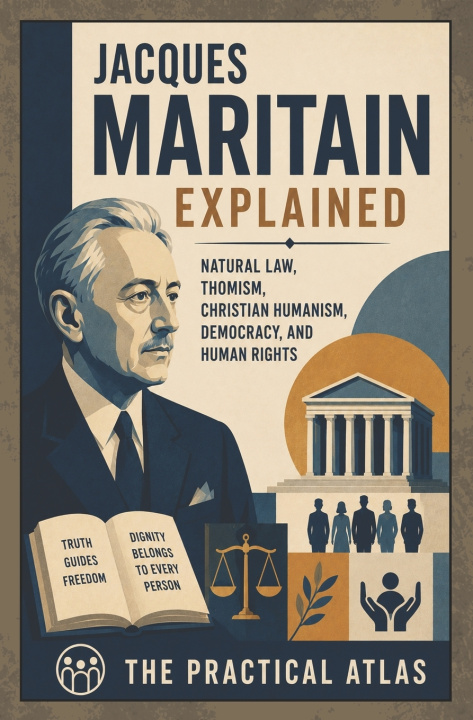
Jacques Maritain Explained
Natural Law, Thomism, Christian Humanism, Democracy, and Human Rights
 Angleščina
 24 b
24 b
 Novo
Novo
Do 30 dni za vračilo

Jacques Maritain Explained: Natural Law, Thomism, Christian Humanism, Democracy, and Human Rights offers a direct introduction to a thinker who brought Thomas Aquinas into modern debates about politics, morality, culture, and the human person. Maritain wrote against reductionist views of human life that treat people as consumers, workers, or instruments of the state. He argued that dignity is rooted in what a person is, not in social usefulness, and that freedom is inseparable from truth and moral responsibility. For readers who want a serious but readabe guide, this book explains Maritain's core ideas without jargon and keeps close to the problems he was trying to solve.
The book opens with Maritain's intellectual journey, including his break with skepticism, his conversion, and his turn to Thomism as a way of understanding reality, knowledge, and moral judgment. It then lays out the basic structure of his thought: how faith and reason relate without canceling each other, why truth is discovered rather than invented, and how natural law names a real moral order rather than a private preference. It also explains his view of the person as a spiritual and social being, his account of conscience as disciplined judgment, and his defense of freedom as the power to choose the good rather than mere self-assertion.
From there, the focus shifts to Maritain's public philosophy. The discussion clarifies his distinction between the individual and the person, his understanding of the common good, and his argument that healthy democracy depends on moral convictions it cannot produce by procedure alone. It examines his defense of pluralist political life, the limits of state power, and the need for civic friendship in societies marked by deep disagreement. The book also traces his role in the development of modern human rights thinking, especially his claim that people can agree on rights in practice even when they disagree about ultimate foundations, while still needing a deeper account of why rights are real.
The closing sections address education, culture, art, and the spiritual conditions of civilization. Maritain's Christian humanism appears here not as a slogan but as a way of holding together contemplation, moral action, and public responsibility. His work speaks with unusual force to contemporary disputes over dignity, secularism, authority, and the shape of freedom. This volume gives students, general readers, and anyone interested in political and moral thought a precise, practical path into one of the twentieth century's most important Catholic philosophers.
FROM THE HALF HOUR HELP SERIES OF BOOKS
The Half Hour Help Series is a collection of concise, practical guides designed to teach the basics of a subject or provide quick solutions to everyday problems. Each book is crafted to be read in about 30-60 minutes, making it ideal for busy readers who want to learn something new or solve a specific issue without wading through lengthy manuals or complex jargon.
Whether you're looking to understand a new concept, develop a skill, or tackle a challenge, these guides break things down into simple, actionable steps.
Focused on clarity and efficiency, the Half Hour Help Series covers a wide range of topics-from personal development and productivity to science and technology, wellness, culture, and beyond.
Every title is built around the idea that a little help can go a long way, and with just half an hour, readers can gain valuable insights and confidence to move forward.
It's smart support when you need it, without the fluff.


O knjigi
Angleščina

Podarite to knjigo še danes
To je povsem preprosto
1 Dodajte knjigo v košarico in izberite dostavo kot darilo 2 V zameno vam bomo poslali kupon 3 Knjiga bo dostavljena na naslov obdarovancaPozdravljeni! Sem Libroamiko, vaš knjižni svetovalec.
Kako vam lahko pomagam?