
 Kontakt
 Kako nakupovati
Dostava
Svetovalec pri nakupu
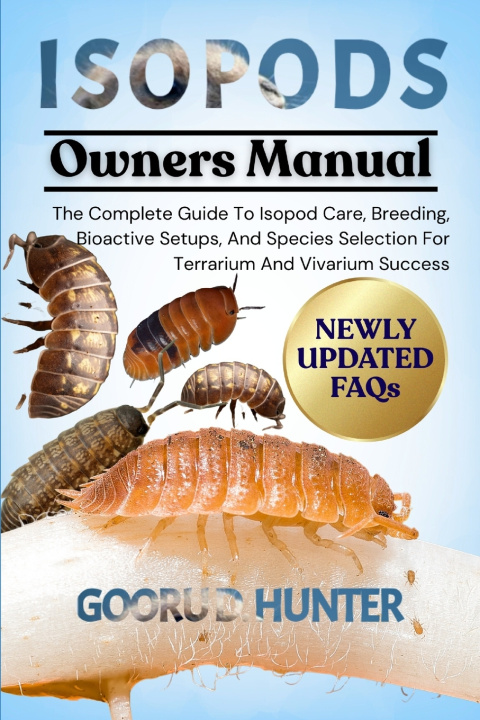
ISOPODS
The Complete Guide To Isopod Care, Breeding, Bioactive Setups, And Species Selection For Terrarium And Vivarium Success
 Angleščina
 34 b
34 b
Do 30 dni za vračilo

Understanding what isopods are, their roles in nature, and why they make fascinating and beneficial pets
What Are Isopods?
Isopods are small, segmented invertebrates that belong to the order Isopoda, within the class Malacostraca. This class also includes shrimp, crabs, and lobsters. While the term "isopod" encompasses thousands of species found both on land and in aquatic environments, this book focuses on terrestrial isopods-specifically those that are kept as pets.
Terrestrial isopods are also known as pill bugs, sow bugs, or woodlice. These names reflect their common appearances and behaviors, like the ability of some species to roll into a tight ball (conglobation) as a defense mechanism. This trait is especially associated with members of the genus Armadillidium. Isopods have a rigid, segmented exoskeleton that gives them a somewhat armored appearance, and their flat, oval bodies are designed for navigating tight spaces within leaf litter and under bark.
Despite their modest size-typically ranging from 5 to 20 millimeters-these creatures have captivated a growing number of hobbyists for their diversity, intriguing behaviors, and practical uses in bioactive terrarium setups.
Basic Anatomy and Physiology
Isopods possess several distinctive features that set them apart from other invertebrates. Their bodies are divided into three primary regions: the head, thorax (also called the pereon), and abdomen (also called the pleon). Each of these sections includes specialized segments that contribute to locomotion, respiration, and sensory perception.
They breathe through pleopodal lungs-modified gills-located on the underside of their abdomens. Because of this unique respiratory system, isopods require a moist environment to facilitate gas exchange. Dry conditions can be fatal, as the gill-like structures dry out rapidly without proper humidity.
Their antennae play an important sensory role, allowing them to navigate their environment through touch and chemical cues. Compound eyes help detect light and motion but are not used for detailed vision. Isopods rely more on chemical and tactile information than on visual input.
Evolution and Global Distribution
Isopods have been around for over 300 million years, evolving to inhabit nearly every type of ecosystem, from the depths of the ocean to arid deserts. Marine isopods are the most ancient and diverse, but terrestrial isopods have adapted impressively to life on land.
Terrestrial species are found on every continent except Antarctica, thriving in habitats rich in decaying organic matter such as forests, grasslands, and gardens. Their global distribution and long evolutionary history reflect their adaptability and ecological significance.
Some of the most popular pet isopods hail from Europe (Armadillidium spp.), the Mediterranean (Porcellio spp.), and Southeast Asia (Cubaris spp.), where they have evolved to display fascinating morphological and behavioral traits.
Ecological Roles in Nature
Isopods serve essential ecological functions, acting as decomposers in terrestrial ecosystems. They feed on decaying plant material, leaf litter, wood, bark, fungi, and even animal remains. In doing so, they help break down complex organic compounds into simpler forms that can be absorbed by plants and microbes.
Their digestive systems contain symbiotic bacteria that help them process cellulose, enabling them to consume a wide variety of decomposing materials that many organisms cannot digest. This contributes to soil aeration, nutrient cycling, and the overall health of forest floors and garden beds.


O knjigi
Angleščina

Podarite to knjigo še danes
To je povsem preprosto
1 Dodajte knjigo v košarico in izberite dostavo kot darilo 2 V zameno vam bomo poslali kupon 3 Knjiga bo dostavljena na naslov obdarovancaPozdravljeni! Sem Libroamiko, vaš knjižni svetovalec.
Kako vam lahko pomagam?