
 Kontakt
 Kako nakupovati
Dostava
Svetovalec pri nakupu
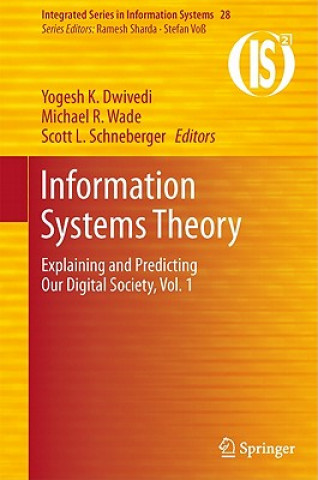
Information Systems Theory
Explaining and Predicting Our Digital Society, Vol. 1
 Angleščina
 480 b
480 b
Do 30 dni za vračilo
Drugi so kupili tudi











The overall mission of this book is to provide a comprehensive understanding and coverage of the various theories and models used in IS research. Specifically, it aims to focus on the following key objectives: §To describe the various theories and models applicable to studying IS/IT management issues. To outline and describe, for each of the various theories and models, independent and dependent constructs, reference discipline/originating area, originating author(s), seminal articles, level of analysis (i.e. firm, individual, industry) and links with other theories. To provide a critical review/meta-analysis of IS/IT management articles that have used a particular theory/model.To discuss how a theory can be used to better understand how information systems can be effectively deployed in today s digital world. This book contributes to our understanding of a number of theories and models. The theoretical contribution of this book is that it analyzes and synthesizes the relevant literature in order to enhance knowledge of IS theories and models from various perspectives. To cater to the information needs of a diverse spectrum of readers, this book is structured into two volumes, with each volume further broken down into two sections. §The first section of Volume 1 presents detailed descriptions of a set of theories centered around the IS lifecycle, including the Success Model, Technology Acceptance Model, User Resistance Theories, and four others. The second section of Volume 1 contains strategic and economic theories, including a Resource-Based View, Theory of Slack Resources, Portfolio Theory, Discrepancy Theory Models, and eleven others. §The first section of Volume 2 concerns socio-psychological theories. These include Personal Construct Theory, Psychological Ownership, Transactive Memory, Language-Action Approach, and nine others. The second section of Volume 2 deals with methodological theories, including Critical Realism, Grounded Theory, Narrative Inquiry, Work System Method, and four others.§Together, these theories provide a rich tapestry of knowledge around the use of theory in IS research. Since most of these theories are from contributing disciplines, they provide a window into the world of external thought leadership.The overall mission of this book is to provide a comprehensive understanding and coverage of the various theories and models used in IS research. Specifically, it aims to focus on the following key objectives: §To describe the various theories and models applicable to studying IS/IT management issues. To outline and describe, for each of the various theories and models, independent and dependent constructs, reference discipline/originating area, originating author(s), seminal articles, level of analysis (i.e. firm, individual, industry) and links with other theories. To provide a critical review/meta-analysis of IS/IT management articles that have used a particular theory/model.To discuss how a theory can be used to better understand how information systems can be effectively deployed in today s digital world. This book contributes to our understanding of a number of theories and models. The theoretical contribution of this book is that it analyzes and synthesizes the relevant literature in order to enhance knowledge of IS theories and models from various perspectives. To cater to the information needs of a diverse spectrum of readers, this book is structured into two volumes, with each volume further broken down into two sections. §The first section of Volume 1 presents detailed descriptions of a set of theories centered around the IS lifecycle, including the Success Model, Technology Acceptance Model, User Resistance Theories, and four others. The second section of Volume 1 contains strategic and economic theories, including a Resource-Based View, Theory of Slack Resources, Portfolio Theory, Discrepancy Theory Models, and eleven others. §The first section of Volume 2 concerns socio-psychological theories. These include Personal Construct Theory, Psychological Ownership, Transactive Memory, Language-Action Approach, and nine others. The second section of Volume 2 deals with methodological theories, including Critical Realism, Grounded Theory, Narrative Inquiry, Work System Method, and four others.§Together, these theories provide a rich tapestry of knowledge around the use of theory in IS research. Since most of these theories are from contributing disciplines, they provide a window into the world of external thought leadership.The overall mission of this book is to provide a comprehensive understanding and coverage of the various theories and models used in IS research. Specifically, it aims to focus on the following key objectives: §To describe the various theories and models applicable to studying IS/IT management issues. To outline and describe, for each of the various theories and models, independent and dependent constructs, reference discipline/originating area, originating author(s), seminal articles, level of analysis (i.e. firm, individual, industry) and links with other theories. To provide a critical review/meta-analysis of IS/IT management articles that have used a particular theory/model.To discuss how a theory can be used to better understand how information systems can be effectively deployed in today s digital world. This book contributes to our understanding of a number of theories and models. The theoretical contribution of this book is that it analyzes and synthesizes the relevant literature in order to enhance knowledge of IS theories and models from various perspectives. To cater to the information needs of a diverse spectrum of readers, this book is structured into two volumes, with each volume further broken down into two sections. §The first section of Volume 1 presents detailed descriptions of a set of theories centered around the IS lifecycle, including the Success Model, Technology Acceptance Model, User Resistance Theories, and four others. The second section of Volume 1 contains strategic and economic theories, including a Resource-Based View, Theory of Slack Resources, Portfolio Theory, Discrepancy Theory Models, and eleven others. §The first section of Volume 2 concerns socio-psychological theories. These include Personal Construct Theory, Psychological Ownership, Transactive Memory, Language-Action Approach, and nine others. The second section of Volume 2 deals with methodological theories, including Critical Realism, Grounded Theory, Narrative Inquiry, Work System Method, and four others.§Together, these theories provide a rich tapestry of knowledge around the use of theory in IS research. Since most of these theories are from contributing disciplines, they provide a window into the world of external thought leadership.


O knjigi
Angleščina

Podarite to knjigo še danes
To je povsem preprosto
1 Dodajte knjigo v košarico in izberite dostavo kot darilo 2 V zameno vam bomo poslali kupon 3 Knjiga bo dostavljena na naslov obdarovancaMorda bi vas zanimalo tudi





 /
/
 Mehka
Mehka
 15.08
€
15.08
€




 /
Mehka
24.24
€
/
Mehka
24.24
€



 /
Trda
135.47
€
/
Trda
135.47
€

 /
Mehka
23.02
€
/
Mehka
23.02
€
 /
Mehka
22.43
€
/
Mehka
22.43
€




 /
Mehka
145.12
€
/
Mehka
145.12
€
Pozdravljeni! Sem Libroamiko, vaš knjižni svetovalec.
Kako vam lahko pomagam?