
 Kontakt
 Kako nakupovati

Dostava
Svetovalec pri nakupu
 Angleščina
 45 b
 Novo
 Bo dostavljeno do božiča ▾
Na zalogi pri dobavitelju
Odposlali bomo v 9-13 dneh
Do 30 dni za vračilo

Have you ever looked at a microwave, a jet engine soaring across the clouds, or a spider spinning its web and wondered: "Wait... how does that actually work?"
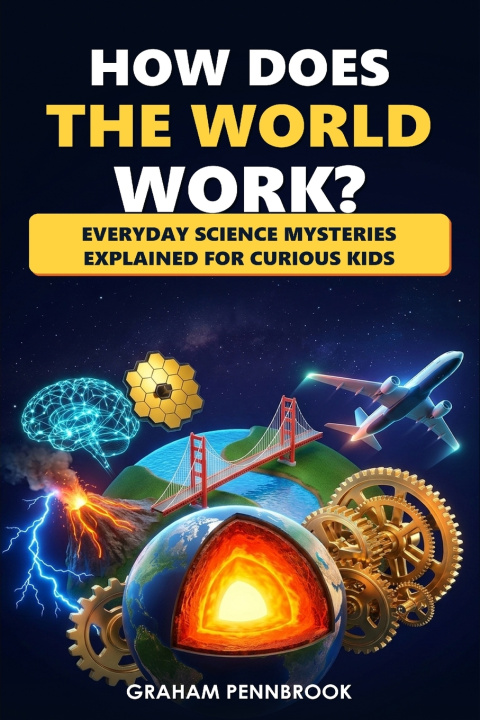
Every day, young minds encounter amazing machines, biological systems, and natural wonders without knowing what happens beneath the surface. Acclaimed author Graham Pennbrook reveals the fascinating science behind everyday life in this illustrated guide.
How Does the World Work? explores how 300 everyday machines, living systems, weather phenomena, and scientific tools operate. Designed for curious readers ages 8 to 12, it explains complex principles through clear, engaging, step-by-step descriptions.
Here is a glimpse of what young thinkers will discover:
• Household Machines: How toasters brown bread, refrigerators remove heat, and vacuum cleaners create suction.
• Vehicles & Engines: How car engines work, jet airliners take off, and submarine ballast tanks control diving.
• Sound & Acoustics: How noise-canceling headphones reduce unwanted sounds and echoes bounce off canyon walls.
• Light & Color: How prisms create rainbows, fireworks produce different colors, and 3D glasses trick your brain.
• Electricity & Digital Tech: How touchscreens detect taps, rechargeable batteries store energy, and Wi-Fi transmits data.
• The Human Body: How stomach acid breaks down food, mitochondria produce cellular energy, and muscles contract.
• The Living Brain: How neurons communicate, why we dream, and how the brain controls movement during sleep.
• Animal Architects: How beavers build dams, termites construct ventilated mounds, and bees create hexagonal honeycombs.
• Plant Mechanics: How tall redwood trees transport water, seeds remain dormant, and leaves exchange gases.
• Earth & Geology: How tectonic plates move, volcanoes erupt, and earthquakes can trigger tsunamis.
• Storms & Lightning: How electrical charges build inside clouds and lightning heats the surrounding air.
• Magnets & Motors: How compasses point north, electric motors turn, and maglev trains float above their tracks.
• Telescopes & Optics: How telescopes collect distant starlight and camera sensors capture images.
• Bridges & Structures: How suspension cables support traffic and expansion joints accommodate temperature changes.
• Thinking Like a Scientist: How to design experiments, develop testable hypotheses, and investigate discoveries at home.
Why Parents, Homeschoolers, and Teachers Love This Book:
• Zero Fluff, Real Mechanisms: Explains physical, chemical, and biological principles using relatable examples.
• Spot It Observation Clues: Helps children recognize science in their homes, backyards, and neighborhoods.
• Safe Family Observations: Introduces simple ways to observe scientific principles using ordinary household items.
• Completely Self-Contained: No write-in blanks or external resources required, making it suitable for e-readers, tablets, and print editions.
More than a collection of interesting facts, this book encourages children to ask questions, observe carefully, and think critically about the world around them.
Whether for bedtime reading, road trips, homeschool science lessons, or independent exploration, How Does the World Work? helps children discover the science behind everyday wonders.
Unlock 300 fascinating mysteries and inspire the next generation of builders, dreamers, and scientists today!


O knjigi
Angleščina
Kategorije

Podarite to knjigo še danes
To je povsem preprosto
1 Dodajte knjigo v košarico in izberite dostavo kot darilo 2 V zameno vam bomo poslali kupon 3 Knjiga bo dostavljena na naslov obdarovancaPozdravljeni! Sem Libroamiko, vaš knjižni svetovalec.
Kako vam lahko pomagam?