
 Kontakt
 Kako nakupovati
Dostava
Svetovalec pri nakupu
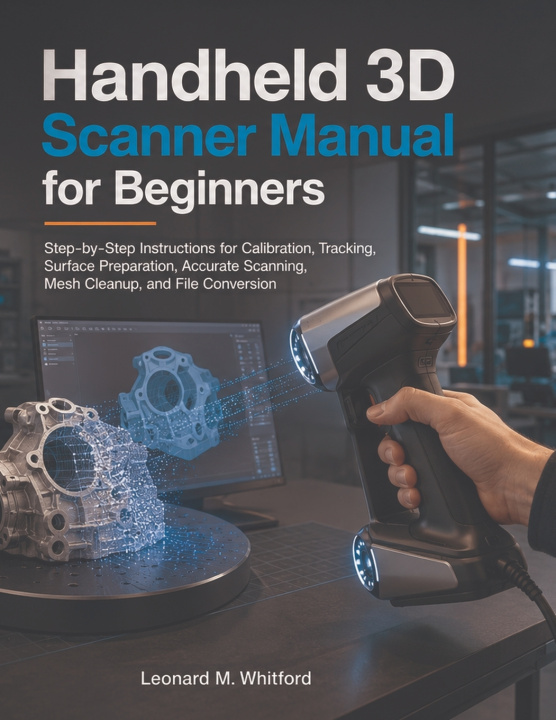
Handheld 3D Scanner Manual for Beginners
Step-by-Step Instructions for Calibration, Tracking, Surface Preparation, Accurate Scanning, Mesh Cleanup, and File Conversion
 Angleščina
 47 b
47 b
 Novo
Novo
Do 30 dni za vračilo

A handheld scanner can collect millions of points and still leave you with a model you cannot use.
Good 3D scanning depends on more than moving a device around an object. Calibration has to be right. The surface must give the scanner something it can read. Tracking has to remain stable. Coverage must be deliberate. And once capture ends, the raw data still needs to become a clean, workable model.
Handheld 3D Scanner Manual for Beginners is built around that complete process.
Instead of overwhelming new users with scanner theory, this practical guide concentrates on the decisions that have the greatest effect on scan quality.
Inside, you will learn how to:
- prepare the scanner, workspace, and object before capture begins;
- understand why calibration matters and recognize when it should be checked again;
- deal more effectively with dark, shiny, smooth, reflective, or difficult surfaces;
- maintain tracking while moving around an object and recover sensibly when tracking is lost;
- choose scanning distance, movement, overlap, and coverage with accuracy in mind;
- recognize missing geometry, noise, duplicate data, and weak surface areas before finalizing a scan;
- align and combine captured sections more carefully;
- clean polygon meshes without destroying useful shape and detail;
- close gaps and improve troublesome areas before export;
- choose suitable file-conversion routes for later modeling, visualization, reverse-engineering, or fabrication work.
The practical advantage is simple: better capture means less repair afterward.
Current professional 3D-scanning workflows likewise treat surface condition, data acquisition, registration, point-cloud or mesh processing, and export as connected stages rather than separate tasks.
This handbook is suitable for beginners, makers, students, technicians, product designers, workshop users, and anyone who has discovered that owning a capable scanner does not automatically produce a clean digital model.
Prepare the object properly, make every pass count, and finish with scan data you can actually take into the next stage of your project.
This is an independent educational guide and is not affiliated with, sponsored by, authorized by, or endorsed by any 3D-scanner manufacturer or software developer. Product specifications, software interfaces, supported file formats, and scanning procedures may vary between devices and may change through later updates.


O knjigi
Angleščina

Podarite to knjigo še danes
To je povsem preprosto
1 Dodajte knjigo v košarico in izberite dostavo kot darilo 2 V zameno vam bomo poslali kupon 3 Knjiga bo dostavljena na naslov obdarovancaPozdravljeni! Sem Libroamiko, vaš knjižni svetovalec.
Kako vam lahko pomagam?