
 Kontakt
 Kako nakupovati
Dostava
Svetovalec pri nakupu
Guidebook to Mathematics
 Angleščina
 46 b
46 b
Do 30 dni za vračilo

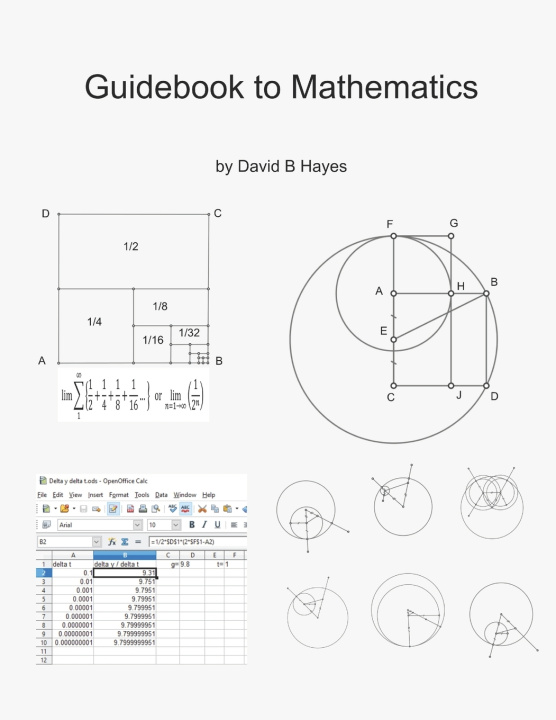
The Guidebook to Mathematics is an aid for helping educators teach mathematics in the Socratic way: by asking questions. For some learners, the beauty of mathematics and the certainty of mathematical truths is transformational. In contrast to the indoctrination found in most textbooks, the Guidebook to Mathematics seeks to spur pleasant interesting conversations about mathematics.
Richard Feynman wrote a story about why his cousin never learned algebra:
"My cousin, who was three years older [than me], was in high school. He was having considerable difficulty with his algebra, so a tutor would come. I was allowed to sit in a corner while the tutor would try to teach my cousin algebra. I'd hear him talking about x.
I'd say to my cousin, "What are you trying to do?"
"I'm trying to find out what x is, like in 2x +7 = 15."
I say, "You mean 4."
"Yeah, but you did it by arithmetic. You have to do it by algebra."
I learned algebra, fortunately, not by going to school, but by finding my aunt's old schoolbook in the attic, and understanding that the whole idea was to find out what x is - it doesn't' make any difference how you do it. For me, there was no such thing as doing it "by arithmetic" or doing it "by algebra." "Doing it by algebra" was a set of rules which, if you followed them blindly, could produce the answer: "subtract 7 from both sides; if you have a multiplier, divide both sides by the multiplier," and so on - a series of steps by which you could get the answer if you didn't understand what you were trying to do. The rules had been invented so that the children who have to study algebra could all pass. And that's why my cousin was never able to do algebra. (Richard P. Feynman and Ralph Leighton, Classic Feynman : all the adventures of a curious character, 1st ed. (New York: W.W. Norton, 2006). p. 17. Bold emphasis added.)
In contrast, Richard Feynman was taught how to learn by his father who was a good teacher.
That's the way I was educated by my father, with those kinds of examples and discussions: no pressure - just lovely, interesting discussions. It has motivated me for the rest of my life and makes me interested in all the sciences. (It just happens I do physics better.)
I've been caught, so to speak - like someone who was given something wonderful when he was a child, and he's always looking for it again. I'm always looking, like a child, for the wonders I know I'm going to find - maybe not every time, but every once in a while. (Richard P. Feynman and Ralph Leighton, Classic Feynman : all the adventures of a curious character, 1st ed. (New York: W.W. Norton, 2006). p. 17)
Even as a professor at Caltech, which by modern standards is a very small university, Feynman recommends that education is effective only when a good teacher has an individual relationship to a student.
I think, however, that there isn't any solution to this problem of education other than to realize that the best teaching can be done only when there is a direct individual relationship between a student and a good teacher - a situation in which the student discusses the ideas, thinks about things, and talks about the things. It's impossible to learn very much by simply sitting in a lecture, or even by simply doing problems that are assigned. But in our modern times we have so many students to teach that we have to find some substitute for the ideal. Perhaps my lectures can make some contributions. Perhaps in some small place where there are individual teachers and students, they may get some inspiration or some ideas from the lectures. Perhaps they will have fun thinking them through - or going on to develop some of the ideas further. (Richard P. Feynman, Robert B. Leighton, and Matthew L. Sands, The Feynman Lectures on Physics, 3 vols. (Reading, Mass.,: Addison-Wesley Pub. Co., 1963). p 5.)


O knjigi
Angleščina
Kategorije

Podarite to knjigo še danes
To je povsem preprosto
1 Dodajte knjigo v košarico in izberite dostavo kot darilo 2 V zameno vam bomo poslali kupon 3 Knjiga bo dostavljena na naslov obdarovancaPozdravljeni! Sem Libroamiko, vaš knjižni svetovalec.
Kako vam lahko pomagam?