
 Kontakt
 Kako nakupovati
Dostava
Svetovalec pri nakupu
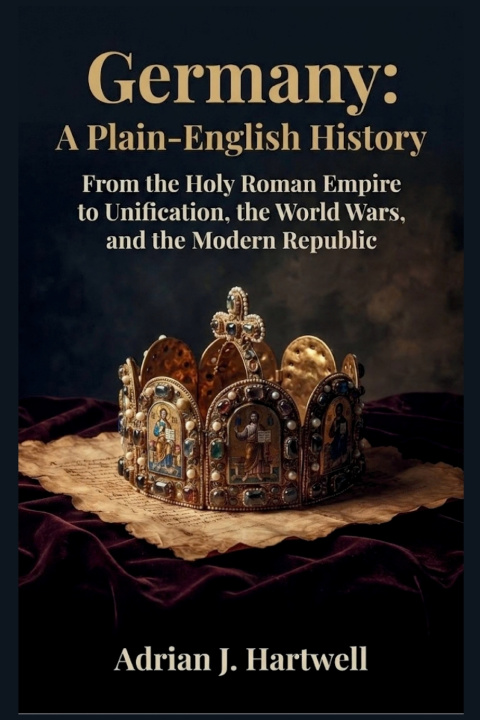
Germany
A Plain-English History: From the Holy Roman Empire to Unification, the World Wars, and the Modern Republic
 Angleščina
 37 b
37 b
 Novo
Novo
Do 30 dni za vračilo

Germany Was Never Supposed to Be One Country
For most of its history, Germany did not exist. There was no German state, no German border, no German flag. There was a bewildering patchwork of kingdoms, duchies, free cities, and petty lordships, bound together by a shared language and a loose imperial framework that was famously described as neither holy, nor Roman, nor an empire.
And yet, by 1871, a German nation-state existed. It had been forged through three wars in less than a decade, orchestrated by a Prussian statesman whose name would become synonymous with realpolitik. How did a collection of hundreds of petty states become one of the most consequential nations in modern history? The answer is not a story of inevitable national awakening. It is a story of contingency, conflict, and choices made by people who could not have known how their decisions would reshape Europe.
Germany: A Plain-English History tells that story from beginning to end. It begins with the Holy Roman Empire, traces the Reformation and the Thirty Years' War, follows the rise of Prussia under the Great Elector and Frederick the Great, and explains how Bismarck used blood and iron to create the German Empire. It then carries the narrative through the Kaiser's ambition, the First World War, the fragile Weimar Republic, the Nazi seizure of power, the Second World War and the Holocaust, the division of Germany, the two Germanys of the Cold War, and the reunification that created the modern Federal Republic.
What You Will Find Inside:
- The Empire That Wasn't: The Holy Roman Empire, its elected emperors, and why it never became a centralized state
- A Patchwork of Princes: The Reformation, the Defenestration of Prague, and the Thirty Years' War
- The Eagle Rising: The Great Elector, Frederick the Great, and the making of Prussia
- Blood and Iron: Bismarck, three wars, and the unification of 1871
- The Kaiser's Ambition: Wilhelm II, Weltpolitik, the naval race, and the road to 1914
- The Guns of August: The First World War, the failure of quick victory, and revolution from below
- A Republic Without Republicans: Weimar, hyperinflation, the Golden Twenties, and collapse
- The Darkest Turn: Hitler's rise, the Nazi seizure of power, and the road to genocide
- The World in Flames: Blitzkrieg, Stalingrad, and the Holocaust
- Zero Hour: Occupation, division, and the Berlin Wall
- Two Germanys: Life in the GDR, the West German economic miracle, and Ostpolitik
- The Unfinished Nation: The fall of the Wall, reunification, and Germany's modern role
Why This Book Is Different
There is no shortage of scholarship on German history, and no shortage of popular books that promise drama and deliver very little substance. What is harder to find is a clear, serious narrative that treats the reader as an intelligent adult who simply does not happen to be a specialist.
That is the gap this book tries to fill. Terms are explained the first time they appear. Complex events are given careful context. Where the historical record is incomplete, or where scholars continue to disagree, the book says so rather than pretending the matter is settled.
The Story Is Not Finished
Germany was not a nation waiting to be born. It was a possibility that had to be created, contested, and defended. Understanding how it came to be is not an exercise in celebrating a national triumph or in explaining a national catastrophe. It is an exercise in understanding how political communities are constructed, how they fracture, and how they endure.
Start reading today, and discover the story of a nation that was never inevitable.


O knjigi
Angleščina

Podarite to knjigo še danes
To je povsem preprosto
1 Dodajte knjigo v košarico in izberite dostavo kot darilo 2 V zameno vam bomo poslali kupon 3 Knjiga bo dostavljena na naslov obdarovancaPozdravljeni! Sem Libroamiko, vaš knjižni svetovalec.
Kako vam lahko pomagam?