
 Kontakt
 Kako nakupovati
Dostava
Svetovalec pri nakupu
 Angleščina
 35 b
35 b
 Novo
Novo
Do 30 dni za vračilo

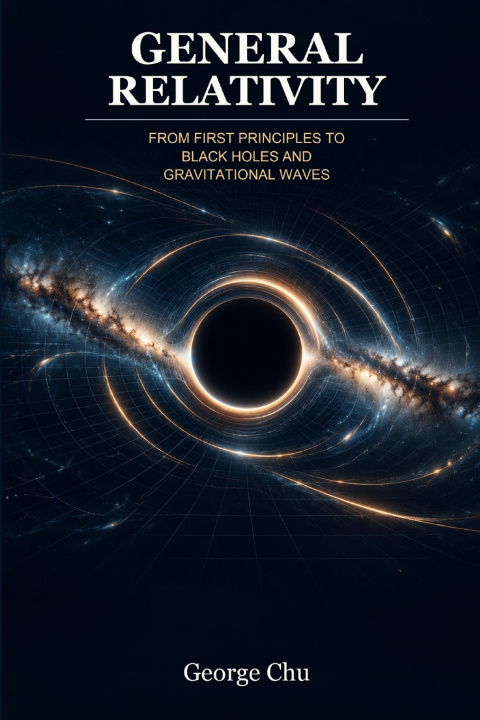
What does it mean to say that gravity is geometry? Why can an orbiting clock and a clock on Earth disagree? How does curvature produce tides, bend light, and shape the motion of stars? Why do merging black holes leave a measurable ripple in spacetime?
General Relativity: From First Principles to Black Holes and Gravitational Waves develops the answers as a connected chain of ideas. Written for advanced undergraduates and beginning graduate students, it begins with the observations that forced physics beyond Newton's picture. It then builds the metric, connections, geodesics, curvature, stress-energy, and Einstein's field equations with the assumptions and physical meaning of each step in view.
This is a book for readers who want to do more than recognize famous formulas. You will learn to derive a prediction from a metric, define the observer who measures it, identify the approximation used, and ask what a real instrument actually records. Worked problems, derivation workshops, mathematical seminars, original scientific diagrams, tables, and contemporary case studies turn abstract geometry into a practical way of reasoning.
Inside the book:
- Spacetime from physical questions: intervals, light cones, clock comparisons, free fall, local inertial frames, and the precise limits of the equivalence principle.
- The mathematical core: manifolds, tensors, the metric, the Levi-Civita connection, parallel transport, variational geodesics, Riemann and Ricci curvature, the Weyl tensor, and geodesic deviation.
- Why the field equations have their form: the Newtonian limit, stress-energy conservation, the contracted Bianchi identity, the Einstein-Hilbert action, boundary terms, and initial-value constraints.
- Exact and approximate predictions: gravitational redshift, light deflection, radar delay, orbital precession, Schwarzschild geometry, horizons, rotating black holes, and the structure of relativistic stars.
- Dynamic gravity: weak gravitational waves, binary inspiral, the chirp mass, merger modeling, quasinormal ringdown, and the distinction between a waveform prediction and detector data.
- The expanding universe: FLRW spacetime, cosmological redshift, distance measures, conservation in a changing geometry, accelerated expansion, and the assumptions behind cosmological inference.
The book also examines how current research tests the theory. Recent gravitational-wave analyses, horizon-scale imaging, polarized emission around M87*, and wide-field lens surveys appear as carefully framed examples. Each case separates the measurement from the model and its uncertainties.
A student can use the chapters as a structured course, the worked problems as exam preparation, and the capstone studies as bridges to research papers. The text states sign conventions and checks weak-field limits so difficult equations remain anchored to familiar physics.
The central promise is clarity without dilution. A coordinate effect is separated from curvature. A horizon is separated from a singularity. Local conservation is separated from an assumed global energy law. A striking image is separated from the inference chain that produced it. Where a derivation relies on symmetry, ideal matter, perturbation theory, or a detector model, that dependence is made explicit.
By the final pages, the reader has a reusable method: begin with events and clocks, construct the geometry, derive motion and field dynamics, and trace each theoretical quantity to a possible measurement. General relativity then becomes more than a collection of celebrated results. It becomes a coherent, testable account of the universe, from a laboratory clock to the largest structures we can observe.


O knjigi
Angleščina
Kategorije

Podarite to knjigo še danes
To je povsem preprosto
1 Dodajte knjigo v košarico in izberite dostavo kot darilo 2 V zameno vam bomo poslali kupon 3 Knjiga bo dostavljena na naslov obdarovancaPozdravljeni! Sem Libroamiko, vaš knjižni svetovalec.
Kako vam lahko pomagam?