
 Kontakt
 Kako nakupovati
Dostava
Svetovalec pri nakupu
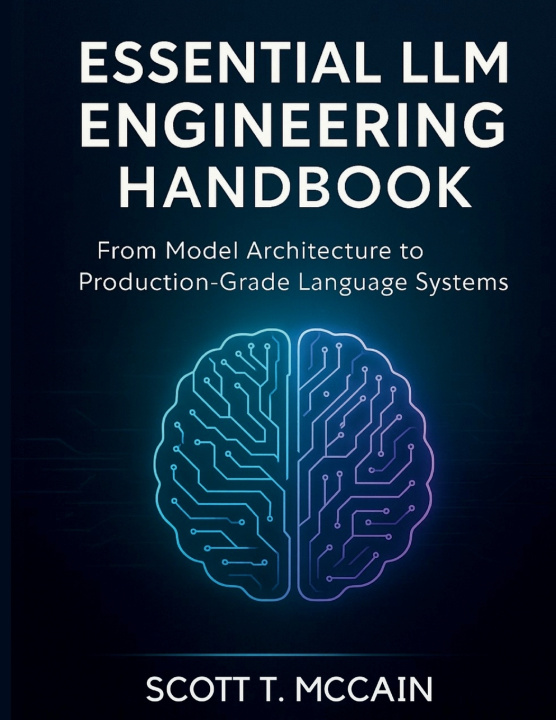
Essential LLM Engineering Handbook
From Model Architecture to Production-Grade Language Systems
 Angleščina
 61 b
61 b
Do 30 dni za vračilo

What does it really take to engineer powerful language systems from the ground up?
Have you ever wondered how large language models move from research papers to real-world production systems? How raw text becomes structured intelligence? Or how engineers transform abstract neural architectures into scalable, reliable applications used in business, research, and automation?
If those questions have crossed your mind, this book was written for you.
Essential LLM Engineering Handbook is a practical, in-depth guide designed for engineers, developers, researchers, and technical leaders who want more than surface-level explanations. This is not just about using language models. It is about understanding them - architecting them, training them, optimizing them, and deploying them responsibly in production environments.
Instead of vague theory, you'll explore the full lifecycle of modern language systems:
- How transformer-based architectures actually work beneath the abstraction
- The principles behind tokenization, embeddings, and attention mechanisms
- Data pipeline design for large-scale training
- Model evaluation, benchmarking, and validation strategies
- Performance optimization and resource efficiency
- Fine-tuning methodologies and domain adaptation
- Infrastructure planning for scalable deployment
- Monitoring, observability, and long-term maintenance
- Safety, alignment, and responsible engineering practices
Have you ever struggled to bridge the gap between experimentation and deployment? Many engineers can build prototypes. Far fewer know how to turn those prototypes into resilient, production-grade systems. This handbook closes that gap.
Scott T. McCain approaches LLM engineering from a systems perspective. You won't just learn isolated techniques - you'll understand how every component connects. From architecture design decisions to compute constraints, from data governance to inference optimization, each chapter builds toward practical mastery.
This book is ideal if you:
- Want to design and build language models rather than simply consume APIs
- Need a structured framework for developing large-scale NLP systems
- Are transitioning from machine learning fundamentals into advanced generative modeling
- Work in AI infrastructure, MLOps, or applied research
- Care about building reliable and maintainable AI systems
The writing is clear, technical without being overwhelming, and grounded in real engineering principles. Complex concepts are broken down logically, without oversimplification. You'll be guided through both foundational theory and hands-on implementation strategies that reflect real-world constraints.
But this handbook also asks a bigger question:
Are we building language systems responsibly?
Beyond architecture and deployment, the book explores safety considerations, evaluation discipline, and long-term system governance. Because engineering powerful AI systems is not just a technical challenge - it's a responsibility.
By the end of this book, you won't just understand how large language models work.
You'll understand how to build them properly.
If you're ready to move beyond experimentation and step into true LLM engineering - this is your guide.


O knjigi
Angleščina

Podarite to knjigo še danes
To je povsem preprosto
1 Dodajte knjigo v košarico in izberite dostavo kot darilo 2 V zameno vam bomo poslali kupon 3 Knjiga bo dostavljena na naslov obdarovancaPozdravljeni! Sem Libroamiko, vaš knjižni svetovalec.
Kako vam lahko pomagam?