
 Kontakt
 Kako nakupovati
Dostava
Svetovalec pri nakupu
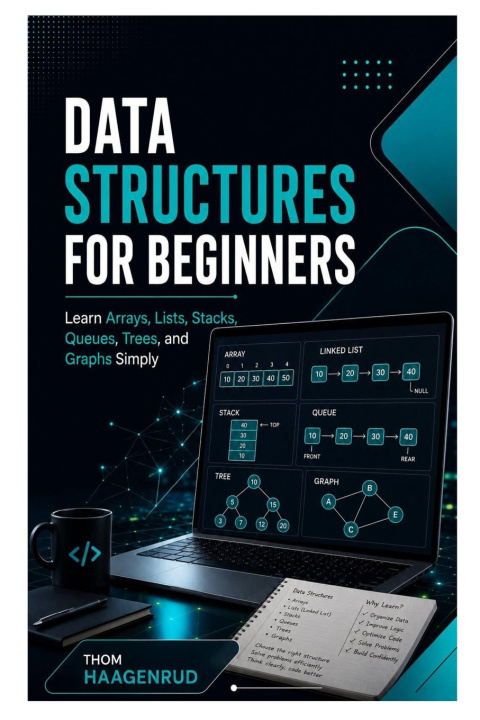
Data Structures for Beginners
Learn Arrays, Lists, Stacks, Queues, Trees, and Graphs Simply
 Angleščina
 44 b
44 b
 Kmalu
Kmalu
 Novo
Novo
Do 30 dni za vračilo

Do you want to understand data structures without getting lost in abstract theory, confusing diagrams, or code examples you cannot explain?
Data Structures for Beginners is a practical, beginner-friendly guide to learning how programs organize information, choose efficient operations, and use the right structure for the right problem. Written for beginners, students, career switchers, self-taught programmers, working developers reviewing fundamentals, and interview candidates, this book teaches data structures through clear explanations, Python examples, operation costs, trade-offs, testing, and a complete capstone project.
Instead of presenting data structures as definitions to memorize, this book teaches them as engineering decisions. You will learn how each structure stores information, which operations it supports well, where it can fail, how performance changes as input grows, and when a standard library collection is usually the better practical choice.
The book follows a practical learning sequence. You begin with problem definition, operations, invariants, references, and Big O. Then you study linear structures such as arrays, linked lists, stacks, queues, and deques. From there, you move into recursion, binary trees, binary search trees, heaps, hash tables, dictionaries, sets, graphs, traversal, shortest paths, and structure-selection decisions.
Python is used for the examples because it keeps the focus on structure and behavior rather than heavy syntax. You will implement educational versions of linked lists, stacks, queues, trees, search trees, heaps, and graphs while also learning when Python's built-in types and standard-library collections are the stronger practical choice.
The examples are built around realistic problems: organizing student records, finding duplicate usernames, tracking daily sales, building a music playlist, checking balanced symbols, implementing undo and redo, processing customer requests, representing an organization, maintaining a scoreboard, scheduling support tickets, counting word frequencies, removing duplicates, modeling transport networks, modeling course prerequisites, and finding routes.
The capstone project brings the book together in a complete Help-Desk Ticket System. You will combine direct lookup, FIFO processing, priority scheduling, undo history, dependency tracking, searching, reporting, validation, error handling, testing, and complexity review into one integrated beginner-friendly application.
This book also teaches practical engineering judgment. You will learn to ask which operations dominate, what must remain true after every update, how the design behaves as input grows, whether memory trade-offs are justified, which invariants need testing, and which standard structure already solves the problem safely.
No formal computer-science background or advanced mathematics is required. You should understand variables, basic data types, conditionals, loops, functions, and simple Python lists. Classes, recursion, complexity notation, trees, heaps, hash tables, and graph terminology are introduced before they are used heavily.
Whether you are preparing for coursework, strengthening weak fundamentals, learning Python-based computer science, preparing for technical interviews, or trying to understand how real software chooses structures, this book gives you a structured path into data structures without unnecessary confusion.
Stop memorizing names and diagrams without knowing when to use them. Learn arrays, lists, stacks, queues, trees, heaps, hash tables, graphs, traversal, shortest paths, testing, and structure selection through examples that show how each decision affects correctness, speed, memory, and maintainability.


O knjigi
Angleščina

Podarite to knjigo še danes
To je povsem preprosto
1 Dodajte knjigo v košarico in izberite dostavo kot darilo 2 V zameno vam bomo poslali kupon 3 Knjiga bo dostavljena na naslov obdarovancaPozdravljeni! Sem Libroamiko, vaš knjižni svetovalec.
Kako vam lahko pomagam?