
 Kontakt
 Kako nakupovati
Dostava
Svetovalec pri nakupu
 Angleščina
 64 b
64 b
Do 30 dni za vračilo

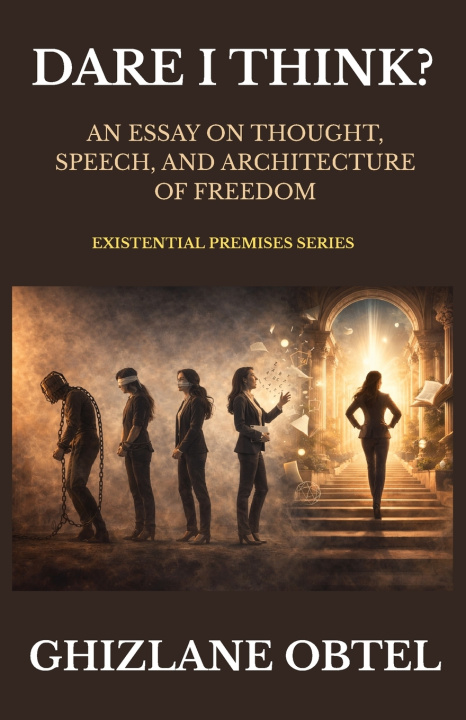
Architecture of Freedom: Symbolic Scaffolding and the Fate of Human Agency
Freedom is not a natural default. It is a structural achievement.
This book argues that human liberty does not arise merely from political arrangements, economic conditions, or biological endowment. It emerges from something deeper and more fragile: the integrity of symbolic scaffolding. Language, law, narrative, ritual, art, philosophy, and institutional memory form the architecture within which thought becomes possible.
Human beings do not think in isolation. We inherit symbolic systems that extend the mind beyond the brain. Conceptual distinctions, moral vocabularies, historical narratives, and shared grammars allow us to reason about complexity, weigh tradeoffs, and project ourselves into possible futures. Freedom, in this sense, is not the absence of constraint but the presence of enabling structure. It depends on access to a rich and plural symbolic environment.
Yet symbolic systems can narrow. Through ideological consolidation, institutional capture, cultural fatigue, technological filtration, or social conformity, the range of permissible categories and narratives may shrink. When symbolic pluralism erodes, nuance collapses into binary moral coding. Emotional signaling replaces deliberation. Historical continuity fragments. Public discourse becomes performative rather than exploratory.
This contraction produces what the book calls constrained cognition: a condition in which individuals retain intelligence but lose access to the full symbolic range required for complex moral reasoning. The effects unfold gradually. Intellectual risk declines. Alternative possibilities become harder to imagine. Moral language simplifies into rehearsed scripts.
At the dystopian endpoint of symbolic narrowing, societies do not necessarily descend into overt terror. Instead, they stagnate. Cognitive homogenization spreads. Moral automation replaces deliberation. Cultural creativity wanes as symbolic diversity disappears. Without shared yet contestable frameworks, collective self-governance becomes unstable. Freedom does not vanish dramatically-it becomes architecturally impossible.
The central claim for this book: human freedom, moral agency, and cultural vitality are inseparable from the integrity of symbolic scaffolding. A free society requires symbolic pluralism, institutional integrity, narrative continuity, moral deliberation, and cognitive humility. These elements function as structural pillars.
The architecture of freedom is not a partisan construct, nor is it bound to a single era. The dynamics of symbolic expansion and contraction have appeared across civilizations. Whenever language hardens into dogma, whenever institutions cease to tolerate inquiry, whenever moral vocabulary narrows to slogans, the same structural vulnerabilities emerge. Conversely, when symbolic ecosystems are revitalized-through intellectual renewal, artistic flourishing, institutional reform, or philosophical rediscovery-agency expands.
This work is both diagnostic and aspirational. It invites readers to consider not only the condition of their societies but the condition of their own symbolic worlds. Where has language narrowed? Where has moral complexity given way to simplification? Where has inherited narrative been abandoned without replacement?
Freedom must be built, protected, and continually reconstructed. It survives not through rhetoric but through the maintenance of cognitive infrastructure. The future of liberty depends less on the defeat of external adversaries than on the preservation of the symbolic architecture that makes independent thought possible.
To defend freedom, we must first understand what makes it thinkable.


O knjigi
Angleščina
Kategorije

Podarite to knjigo še danes
To je povsem preprosto
1 Dodajte knjigo v košarico in izberite dostavo kot darilo 2 V zameno vam bomo poslali kupon 3 Knjiga bo dostavljena na naslov obdarovancaPozdravljeni! Sem Libroamiko, vaš knjižni svetovalec.
Kako vam lahko pomagam?