
 Kontakt
 Kako nakupovati

Dostava
Svetovalec pri nakupu
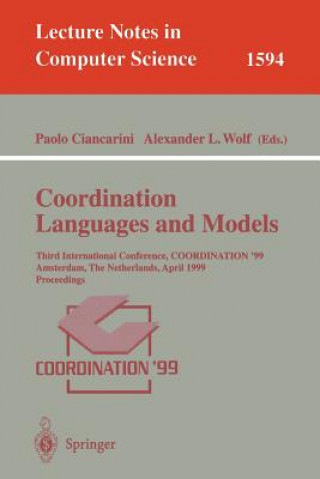
Coordination Languages and Models
Third International Conference, COORDINATION '99, Amsterdam, The Netherlands, April 26-28, 1999. Proceedings
 Angleščina
 118 b
Do 30 dni za vračilo
Drugi so kupili tudi









 /
 Mehka
 15.14
€




 /
 Adobe ePub DRM
49.45
€









We welcome you to Coordination 99, the third in a series of conferences d- icated to an important perspective on the development of complex software systems. That perspective is shared by a growing community of researchers - terested in models, languages, and implementation techniques for coordination. The last decade has seen the emergence of a class of models and languages variously termed coordination languages , con?guration languages , arc- tectural description languages , and agent-oriented programming languages . Theseformalismsprovideacleanseparationbetweenindividualsoftwarecom- nents and their interaction within the overall software organization. This se- ration makes complex applications more tractable, supports global analysis,and enhances the reuse of software components. The proceedings of the previous two conferences on this topic were published by Springer as Lecture Notes in Computer Science 1061 and 1282. This issue of LNCS containing the papers presented at Coordination 99 continues the tradition of carefully selected and high quality papers representing the state of the artin coordinationtechnology.In responseto thecallfor papers,wereceived 67 submissions, from which 26 papers were accepted. These proceedings also contain abstracts for posters presented at the conference. This year s program features invited talks by Rocco De Nicola and Danny B. Lange. Reading through the papers, we expect that you may be surprised by the variety of disciplines within computer science that have embraced the notion of coordination. In fact, we expect this trend to continue, and hope that you will contribute to the on-going exploration of its strengths, weaknesses, and applications.


O knjigi
Angleščina
Kategorije

Podarite to knjigo še danes
To je povsem preprosto
1 Dodajte knjigo v košarico in izberite dostavo kot darilo 2 V zameno vam bomo poslali kupon 3 Knjiga bo dostavljena na naslov obdarovancaMorda bi vas zanimalo tudi






















Pozdravljeni! Sem Libroamiko, vaš knjižni svetovalec.
Kako vam lahko pomagam?