
 Kontakt
 Kako nakupovati

Dostava
Svetovalec pri nakupu
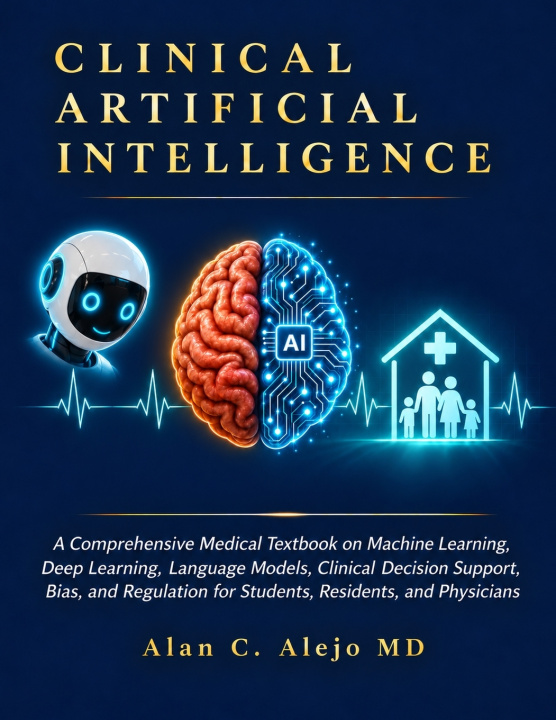
Clinical Artificial Intelligence
A Comprehensive Medical Textbook on Machine Learning, Deep Learning, Language Models, Clinical Decision Support, Bias, and Regulation for Students, Residents, and Physicians
 Angleščina
 674 b
 Kmalu
 Novo
Do 30 dni za vračilo

The sepsis alert stayed silent. The AI read the scan as normal. The drafted note looked fine, so you signed it. Hours later, the patient is crashing, and the chart shows one name: yours.
This is the risk every clinician now carries. AI tools are already deciding which patients get flagged, which scans get read first, and what goes into the record. When they are wrong, the software does not answer for it. The law, the hospital, and the patient look to the clinician who acted on it. Yet almost no one was trained to tell a trustworthy model from a dangerous one.
So clinicians fall into one of two traps. They trust the output because it came from a computer, and miss the cancer, the bleed, or the sepsis case the tool never flagged. Or they ignore it entirely, and fall behind colleagues, hospitals, and examinations that expect them to understand it. Either way, patients pay the price, and so do careers.
Clinical Artificial Intelligence gives you the protection you were never taught. It shows you exactly what to ask before you trust any AI tool: what the model was given, what question it really answers, how well it performed in patients like yours, and who checked it. No programming is required. Every accuracy claim is worked through in counts of real patients, so you see how many alerts a tool fires for every true case and how many patients it quietly misses.
Its 31 chapters, in seven parts, take you from probability and clinical data through machine learning, deep learning, and large language models, then teach how models are measured, validated, and appraised. Eight chapters follow AI into radiology, pathology, cardiology, dermatology, ophthalmology, endoscopy, critical care, oncology, and primary care. The final parts cover decision support, implementation, algorithmic bias, ethics, liability, and FDA regulation, so you know where responsibility sits before a case goes wrong.
Inside this book
- 31 chapters in seven parts, from clinical data to regulation
- 200 review questions in the style of the clinical informatics board examinations, with full explanations and a Key Principle for each
- 34 figures: calibration and ROC curves, model pipelines, and algorithms
- 18 clinical vignettes in which a tool meets a patient and the reasoning that keeps the patient safe, plus Chapter Summaries and Key Concepts
- Appendix of 20 quick-reference tables: formulas, reporting standards, regulatory pathways, and data standards
- Glossary of 370 essential terms
BONUS: 800 more board review questions
Every copy includes 800 additional board review questions with full explanations, for 1,000 questions in all. Scan the QR code on the last page of the book and start practicing on your phone, tablet, or computer.
Written for medical students, residents, and physicians who use, judge, or supervise AI in patient care, and for anyone preparing for clinical informatics examinations.
The next AI output you sign could be the one that is wrong. Know before you trust it. Understand the model. Question the output. Protect the patient.


O knjigi
Angleščina

Podarite to knjigo še danes
To je povsem preprosto
1 Dodajte knjigo v košarico in izberite dostavo kot darilo 2 V zameno vam bomo poslali kupon 3 Knjiga bo dostavljena na naslov obdarovancaPozdravljeni! Sem Libroamiko, vaš knjižni svetovalec.
Kako vam lahko pomagam?