
 Kontakt
 Kako nakupovati
Dostava
Svetovalec pri nakupu
 Angleščina
 52 b
52 b
 Kmalu
Kmalu
 Novo
Novo
Do 30 dni za vračilo

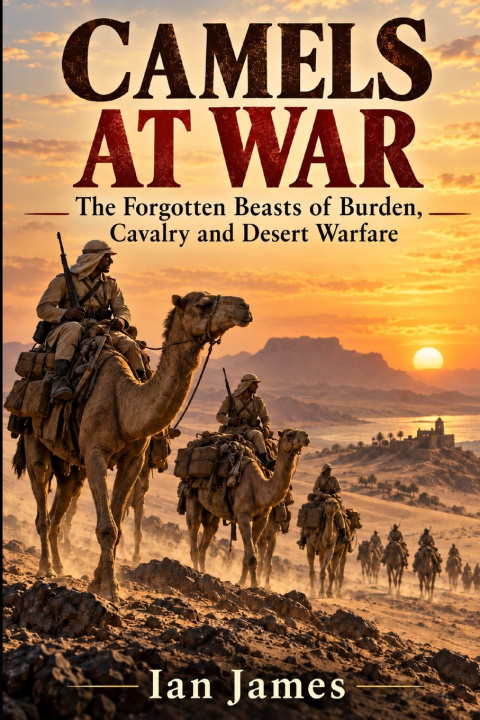
Camels at War
The Forgotten Beasts of Burden, Cavalry and Desert Warfare
For thousands of years, armies crossing the world's great deserts depended on one animal above all others.
The camel carried soldiers, ammunition, food, water, medical supplies, communications equipment, and weapons through terrain where horses struggled and vehicles later became trapped. From ancient Persia and Arabia to the Sudan, India, North Africa, Sinai, Palestine, and the battlefields of the First World War, camels quietly made military operations possible.
Camels at War tells the remarkable and largely forgotten story of the animals that carried warfare across some of the harshest landscapes on earth.
Discover how camels became indispensable to imperial armies, frontier patrols, raiding forces, and military transport systems. Follow the British camel regiments of the Sudan, the famous Bikaner Camel Corps of India, French Saharan méharistes, Ottoman transport columns, the Imperial Camel Corps of the First World War, and the Arab camel forces associated with the revolt made famous by T. E. Lawrence.
The book explores the enormous logistical challenge of crossing Sinai, where railways and water pipelines could only reach so far and thousands of camels carried the supplies needed for the advance into Palestine. It examines their role at Gaza and Beersheba, in attacks on the Hejaz Railway, and in the struggle to sustain Ottoman forces across Arabia and the Middle East.
But this is not only the story of military units and campaigns.
It is also the story of the animals themselves.
Readers will discover how military camels were selected, trained, saddled, loaded, watered, fed, and treated when injured. The book examines riding saddles, pack equipment, panniers, water carriers, ammunition loads, medical transport, camel drivers, veterinary care, and the difficult personalities that gave the camel its unforgettable reputation among soldiers.
Camels could bite, kick, groan, refuse to cooperate, and test the patience of even experienced handlers. Yet when the road ended and the next dependable water source lay far beyond the horizon, few animals could match their endurance.
The final chapters trace the camel into the mechanical age, when trucks, aircraft, radios, and improved roads gradually reduced its military importance. Even during the Second World War, however, camels continued to serve in remote patrol and transport roles where machines could not yet completely replace them.
Camels at War also includes detailed appendices covering:
- Major military camel units
- Military camel saddles and equipment
- Caring for the military camel
- Camels compared with horses, mules, donkeys, and other military animals
- Military camel terminology
- Collecting and identifying Camel Corps militaria
- Bibliography and further reading
Written for military-history readers, collectors, animal-history enthusiasts, and anyone fascinated by the overlooked machinery of warfare, Camels at War reveals a world in which victory often depended not on the fastest weapon, but on the animal capable of carrying it across the desert.
The generals planned the campaigns. The soldiers fought the battles. But the camels carried the war.


O knjigi
Angleščina

Podarite to knjigo še danes
To je povsem preprosto
1 Dodajte knjigo v košarico in izberite dostavo kot darilo 2 V zameno vam bomo poslali kupon 3 Knjiga bo dostavljena na naslov obdarovancaPozdravljeni! Sem Libroamiko, vaš knjižni svetovalec.
Kako vam lahko pomagam?