
 Kontakt
 Kako nakupovati
Dostava
Svetovalec pri nakupu
 Angleščina
 59 b
59 b
 Novo
Novo
Do 30 dni za vračilo

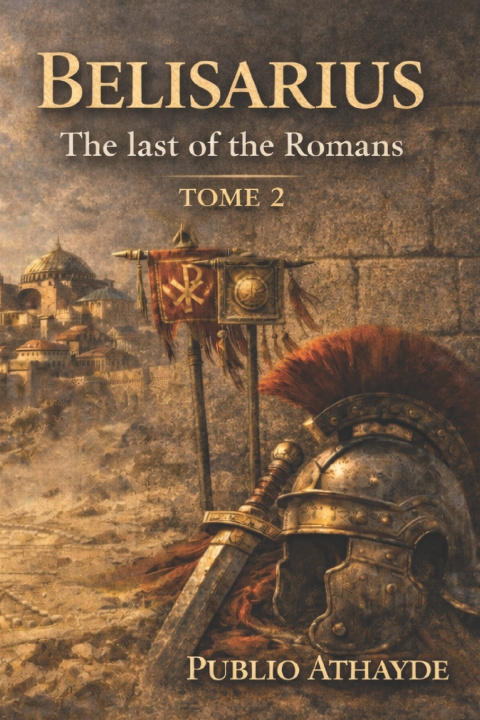
Belisarius: The Last of the Romans presents a carefully constructed narrative of one of the Byzantine Empire's most formidable generals during the reign of Justinian I. Written in the first person through the voice of Procopius of Caesarea, the novel traces a series of campaigns and crises that defined the balance of power across the Mediterranean in the sixth century.
From the fortified lines at Dara to the difficult retreat at Callinicum, from the upheaval of the Nika revolt in Constantinople to the reconquest of North Africa and the prolonged war in Italy, the book follows events that tested both military skill and political judgment. These episodes are not treated as isolated milestones, but as parts of a continuous process in which each decision carries consequences beyond the battlefield.
The narrative places particular emphasis on the mechanics of imperial action. Strategy unfolds alongside uncertainty; command is exercised within limits set by distance, resources, and shifting loyalties. Victories demand consolidation, and success often introduces new risks. The empire that emerges from these pages is neither static nor secure, but engaged in a constant effort to maintain coherence across diverse territories and pressures.
By adopting Procopius' perspective, the work draws attention to the act of writing itself. The narrator records events while reflecting on their meaning, aware that any account is shaped by what is chosen, omitted, or restrained. This dual movement, between observation and interpretation, creates a text that engages with the complexities found in Procopius' own works, including History of the Wars and Secret History, without dissolving their tensions.
Belisarius is portrayed with restraint and nuance. His career does not follow a simple arc of ascent or decline. Instead, it reveals the interplay between individual capacity and the conditions that frame it. Recognition is uncertain, outcomes are provisional, and the line between success and failure remains fluid. Through him, the reader encounters an imperial structure that continues to act decisively even as its internal balance grows more fragile.
The prose maintains a disciplined clarity, combining detailed reconstruction with a broader reflection on power, memory, and responsibility. Military operations are rendered with precision, yet always connected to the larger question of how authority is exercised and preserved. The narrative invites attention to detail while sustaining a steady intellectual rhythm.
Belisarius: The Last of the Romans is suited to readers interested in late antiquity, Byzantine history, and the enduring relationship between warfare and political order. It offers not only a reconstruction of events, but an inquiry into how those events are understood and remembered.
This is a study of conflict, but also of continuity. It considers what persists beyond immediate outcomes, and how experience is shaped into narrative. In doing so, it situates the figure of Belisarius within a broader reflection on action, judgment, and the limits of control in a changing world.


O knjigi
Angleščina

Podarite to knjigo še danes
To je povsem preprosto
1 Dodajte knjigo v košarico in izberite dostavo kot darilo 2 V zameno vam bomo poslali kupon 3 Knjiga bo dostavljena na naslov obdarovancaPozdravljeni! Sem Libroamiko, vaš knjižni svetovalec.
Kako vam lahko pomagam?