Kontakt
 Kako nakupovati
Dostava
Svetovalec pri nakupu
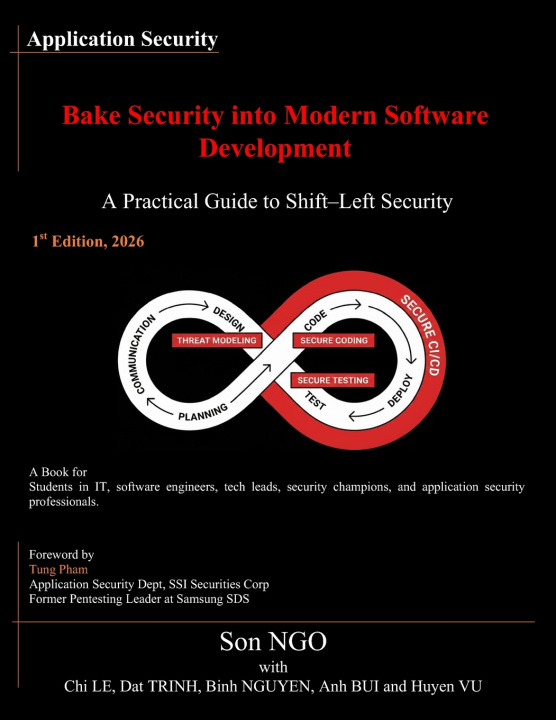
Bake Security into Modern Software Development
A Practical Guide to Shift-Left Security
 Angleščina
 146 b
146 b
 Novo
Novo
30 dni za vračilo blaga
Drugi so kupili tudi




Step into the world of Secure SDLC with this practical guide that takes you from fundamentals to shipping secure software. Learn how to integrate security into requirements, design, implementation, and testing, then operationalize it through lightweight gates and measurable outcomes - so security is part of delivery, not a last-minute audit.
Key Features:
Turn shift-left security into an end-to-end workflow across the SDLC - from requirements to release
Apply threat modeling and secure design thinking to reduce risk before code is written
Use secure coding guidance mapped to common vulnerability classes and real failure modes
Build evidence-driven quality gates (requirements/design review, bug bar, release readiness) - to enforce consistency without slowing teams down
Integrate security testing into CI/CD and triage findings with an engineering-friendly process
Book Description:
Software runs the core of nearly every organization, and security failures rarely come from a single "bad line of code." They emerge from early decisions - ambiguous requirements, risky trust boundaries, missing abuse cases, weak defaults, and untested assumptions. This book shows how to prevent those failures by baking security into modern software development through a structured Secure SDLC approach.
You will focus on how teams actually work: capturing security-relevant requirements, modeling threats and trust boundaries, selecting mitigations and patterns, writing secure code, and validating with security testing that fits your delivery model. Practical artifacts - checklists, templates, and gate criteria - help you scale security across products while keeping delivery predictable.
Throughout the book, you build a repeatable workflow you can adapt to different stacks and maturity levels - for web, enterprise, and cloud-native systems. You learn to reduce exploitable bug chains and keep assumptions verified over time.
Artifacts keep teams aligned too.
By the end, you will be able to implement a Secure SDLC program that improves security outcomes without unnecessary bureaucracy - with clear phase-by-phase actions, evidence to collect, and a shared definition of "done".
What you will learn:
Translate security goals into actionable requirements and quality criteria
Perform threat modeling using trust boundaries, abuse cases, and risk-driven prioritization
Apply secure design principles, patterns, and mitigations that fit real trade-offs
Prevent common vulnerabilities with secure coding practices and lightweight reviews
Integrate security testing (SAST, DAST, dependency/SBOM checks) into CI/CD
Define and run security gates such as design review, bug bar, and release readiness
Triage and fix findings efficiently while improving feedback loops over time
Who this book is for
Software engineers, tech leads, security champions, and application security professionals who want a practical, systematic way to build secure software. Familiarity with modern delivery (CI/CD, cloud, web or microservices) is helpful.
Table of Contents
Secure SDLC overview and mindset
Requirements modeling with security in mind
Architecture and Design
Threat modeling and risk-driven prioritization
- 1 Mitigations, Security Patterns and Cryptography in Secure SDLC
Secure coding foundations and common vulnerability classes
Security testing strategy and toolchain integration
Secure CI/CD Pipeline


O knjigi
Angleščina

Podarite to knjigo še danes
To je povsem preprosto
1 Dodajte knjigo v košarico in izberite dostavo kot darilo 2 V zameno vam bomo poslali kupon 3 Knjiga bo dostavljena na naslov obdarovancaMorda bi vas zanimalo tudi




 /
/
 Mehka
Mehka
 46.73
€
46.73
€