
 Kontakt
 Kako nakupovati
Dostava
Svetovalec pri nakupu
 Angleščina
 75 b
75 b
Do 30 dni za vračilo

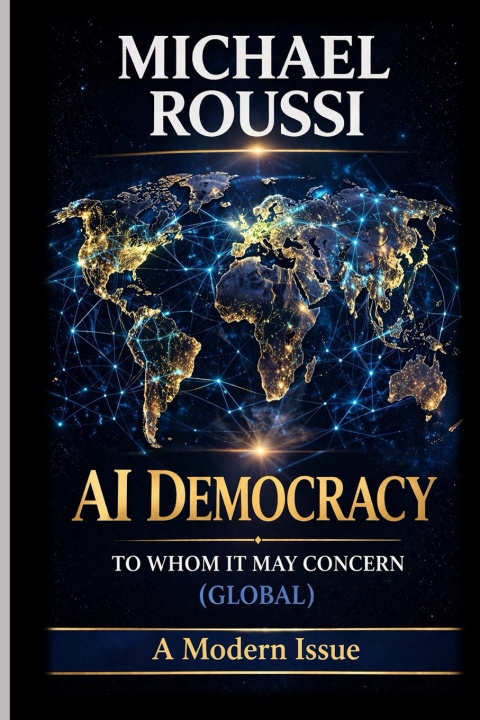
AI Democracy: To Whom It May Concern (Global) presents a clear structural examination of democracy as a system operating in an environment that has already changed. This book does not argue against democracy, and it does not promote technology as a governing force. It focuses on alignment. It explains how democratic systems were designed under past conditions and how those same systems behave when those conditions no longer exist.
The book begins by defining democracy in structural terms. It explains how participation, representation, decision formation, and execution operate as connected components of a system. It shows that the current democratic model was built when communication was slow, information was limited, and coordination across populations required layers of mediation. Representation, periodic participation, and administrative interpretation were necessary under those conditions. They were not flaws. They were structural solutions to environmental constraints.
From this foundation, the book examines how the system behaves today. It shows that delays in decision making, distortion of information, and misalignment between public intent and outcomes are not random failures. They are predictable results of system design. When participation occurs at intervals, outcomes are delayed. When decisions are interpreted by intermediaries, outcomes reflect interpretation. When information flows through layers, clarity is reduced before it reaches individuals. The system behaves as designed, but the environment has changed.
The book then introduces the turning point. The environment now operates on continuous interaction. Information is available in real time. Individuals engage with systems directly. Artificial intelligence can process large volumes of data and manage execution with consistency. These conditions redefine what is possible. However, democratic systems continue to operate on structures designed for a different environment. This creates friction between how people live and how governance functions.
The core of the book presents a structured evolution of democracy. It does not replace democracy. It aligns it. It introduces Digital Civic Identity to enable continuous participation. It presents structured policy frameworks that remove ambiguity and allow direct interaction. It explains how decision making can move from periodic events to continuous input. It removes layers that distort participation by allowing individuals to interact directly with policy.
A critical principle is maintained throughout the book. Human authority does not change. Individuals define decisions. Artificial intelligence does not decide. It operates as the execution layer. It structures information, validates participation, manages processes, and ensures that outcomes are implemented exactly as defined. This separation preserves democracy while enabling precision and scalability.
The final sections describe how the system operates when fully aligned. Governance Artificial Intelligence maintains system integrity. It ensures continuous accountability, real time transparency, and consistent execution. Government operates as the execution interface, not the decision maker. The system becomes a direct reflection of participation across the population.
This book is written in plain American English and structured for clarity. Each section builds logically from definition to evaluation, then to evolution and execution. It avoids opinion, ideology, and persuasion. It focuses on structure and cause and effect.
AI Democracy is not a prediction. It is an observation of a system already in transition. It explains how democracy evolves when its structure aligns with the environment in which it operates. It shows how governance can function in a world defined by continuous interaction and artificial intelligence enabled systems.


O knjigi
Angleščina

Podarite to knjigo še danes
To je povsem preprosto
1 Dodajte knjigo v košarico in izberite dostavo kot darilo 2 V zameno vam bomo poslali kupon 3 Knjiga bo dostavljena na naslov obdarovancaPozdravljeni! Sem Libroamiko, vaš knjižni svetovalec.
Kako vam lahko pomagam?