
 Kontakt
 Kako nakupovati
Dostava
Svetovalec pri nakupu
 Angleščina
 42 b
42 b
Do 30 dni za vračilo

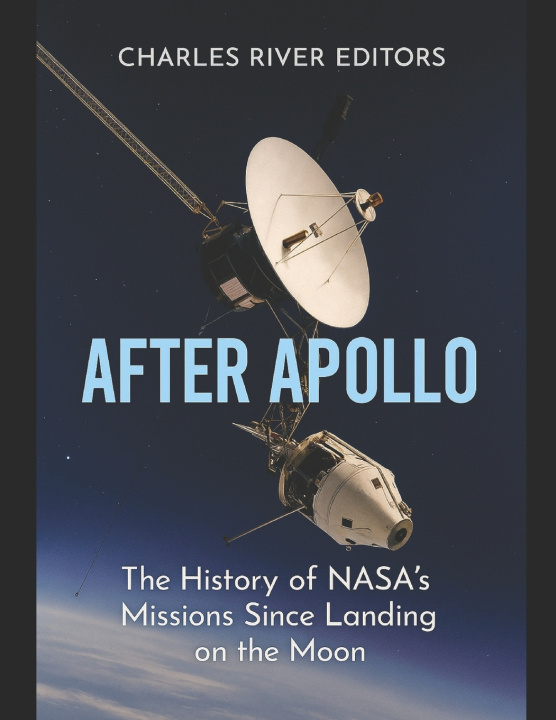
Today the Space Race is widely viewed poignantly and fondly as a race to the Moon that culminated with Apollo 11 "winning" the Race for the United States. In fact, it encompassed a much broader range of competition between the Soviet Union and the United States that affected everything from military technology to successfully launching satellites that could land on Mars or orbit other planets in the Solar System. Moreover, the notion that America "won" the Space Race at the end of the 1960s overlooks just how competitive the Space Race actually was in launching people into orbit, as well as the major contributions the Space Race influenced in leading to today's International Space Station and continued space exploration.
Space exploration was always an expensive business, and throughout NASA's history, the agency has had to justify to Congress its need for every dollar it intended to spend. This problem has helped NASA to be more careful and more creative with the money they did receive, and scientists had to justify the equipment they wanted to include on each space probe. They had to justify the size and the power demand, too. If they wanted too much, the entire mission might be scrubbed, and all their work would have been for naught. This made planning and designs leaner and more efficient, as scientists and engineers were more careful with their recommendations.
At the same time, scientists have been repeatedly surprised by their discoveries. Some of those discoveries revealed the dangers of space, like the Van Allen radiation belt, dangerous to astronauts without the right kind of protection. NASA also discovered the massive radiation belt surrounding Jupiter thanks to the Pioneer probes in 1973 and 1974. Similarly, with the knowledge that Titan, the largest moon of Saturn, has a thick atmosphere, later missions were sent to investigate the moon up close. Thus, the Huygens lander pierced the Titan atmosphere in January of 2005 to investigate.
Although Apollo 11's successful mission to the Moon is seen as the culmination of the Space Race, and the Apollo program remains NASA's most famous, one of the space agency's most successful endeavors came a few years later. In fact, the Pioneer program was the most diversified sequence of any of NASA's programs, and though they're now remembered for being among the first probes in history to reach the Outer Solar System, the elaborate planning changed goals several times over several years before resulting in historic successes. NASA had wanted to do a Grand Tour of the Solar System toward the end of the 1970s to take advantage of the scheduled alignment of planets, which meant the Pioneer missions were meant to be test runs prior to the main events (Voyager 1 and Voyager 2), and a great many things discovered by Pioneer 10 and Pioneer 11 were essential to the successful planning of the Voyager probes.
In November 1971, NASA's Mariner 9 became the first spacecraft to enter Mars' orbit, but the Soviets' Mars 2 and Mars 3 spacecrafts were hot on its heels. Mariner 9 was designed to orbit around Mars, but the Soviets' spacecrafts had descent modules designed to actually land on the Red Planet's surface. The descent module aboard Mars 2 crash landed on Mars' surface on November 27, but less than a week later, Mars 3's descent module began its historic descent down to the surface. On December 2, 1971, after a few hours of descending, it successfully completed its "soft landing."
In 1972 and 1973, NASA sent nine astronauts to spend extended periods of time living in a craft named Skylab, the very first experimental American space station. Though Skylab would not last long, and the International Space Station remains far more famous, Skylab's history is one of ingenuity and challenge, as well as how NASA found itself without a mission after the triumph of the Apollo Program.


O knjigi
Angleščina
