
 Kontakt
 Kako nakupovati
Dostava
Svetovalec pri nakupu
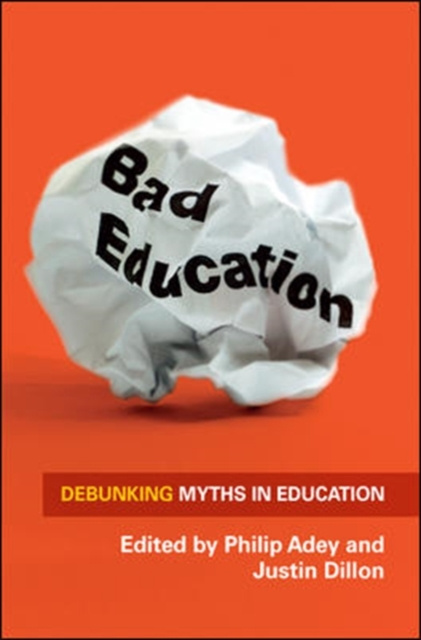
EBOOK: Bad Education: Debunking Myths in Education
 Angleščina
 73 b
73 b

"e;This is an important and welcome book. Readers can see the faults of simplistic judgments, neglect of evidence, dismissal of researchers, and injudicious implementation."e;From the foreword by Paul BlackWe all know that small classes are better than large classes; that children are best taught in groups according to their ability; that some schools are much better than others and that we should teach children according to their individual learning styles ... or do we? This book asks awkward questions about these and many other sacred cows of education. Each chapter tackles a persistent myth in education, confronting it with research evidence and teasing out any kernel of truth which may underlie the myth. Leading authors from the world of education each bring analysis and expertise to bear on their chosen subject, presenting their argument in an accessible manner based on sound scholarship.Some of the conclusions drawn in Bad Education are likely to be real eye-openers for many teachers and parents, who will find some of their basic assumptions about education called into question. It is also essential reading for anyone involved in educational policy making or management.Contributors: Philip Adey, Mike Anderson, Ed Baines, Paul Black, Peter Blatchford, Margaret Brown, Guy Claxton, Frank Coffield, Justin Dillon, Julian (Joe) Elliott, Simon Gibbs, Jeremy Hodgen, Neil Humphrey, Annette Karmiloff-Smith, Bill Lucas, Bethan Marshall, Brian Matthews, Corinne Reid, Rob Webster, Dylan WiliamAs education policymakers it can be difficult to resist the comfort of our own experience and gut instincts or the lure of populism. Bad Education is an invaluable myth-buster that tears down common misconceptions and serves up hard facts in their place. This is a politically unpalatable guide to the evidence that will challenge policymakers, the press and parents alike.Dale Bassett, Head of Public Policy, AQAKenneth Baker describes in his memoirs how education policy was influenced by Margaret Thatchers hairdresser and possibly her cleaner. More recently policy has been justified by the selective use of research in an attempt to create legitimacy for policy changes.Bad Education seeks to address some of the most important issues facing education without resorting to the rhetoric of ideologues or detailed statistical analysis. Instead an acknowledged expert in each issue facing education looks carefully at the available evidence. These issues range from how schools are organized, to teaching methods and learning. Each of the issues examined is one that has many myths associated with it.The authors show, in an clear and compelling way, that too much of what is being done in schools is being decided upon based on the selective use of evidence. Vocational education, ability grouping, class size, use of teaching assistants, synthetic phonics, learning styles, brain training and dyslexia are just some of the issues where the evidence is presented, in an engaging and easy to digest manner, and where all of those in education should take notice of the conclusions. In some cases the evidence is helpfully conclusive. In others it is inconclusive and messy.As we constantly seek to redefine what is best for the next cohort of children to enter education Adey and Dillon, in this highly readable and well edited book, provide us with the evidence as to what does really does make a difference. Perhaps more importantly they move the debate on from gut instinct and myths to looking at the evidence.This book should become a manifesto for change for all of those in education who want to ensure our children do not receive a Bad Education. Every Headteacher should buy a copy for every teacher and hopefully somebody might even place a copy under the Secretary of States Xmas tree.Gary Phillips, Head Teacher, Lilian Bayliss SchoolThis is a welcome and important book. It takes apart the myths which support the dearly held convictions, simplistic assumptions, prejudices and irrational certainties of both politicians and teachers. Admitting that education is not itself a science, but demonstrating how both neuroscience and psychology have become available to inform educational policy and practice, it should provide food for more careful and well-informed thought to all who can influence what happens in our schools.Baroness Perry of Southwark


O knjigi
Angleščina

Podarite to knjigo še danes
To je povsem preprosto
1 Dodajte knjigo v košarico in izberite dostavo kot darilo 2 V zameno vam bomo poslali kupon 3 Knjiga bo dostavljena na naslov obdarovancaPozdravljeni! Sem Libroamiko, vaš knjižni svetovalec.
Kako vam lahko pomagam?