
 Kontakt
 Kako nakupovati
Dostava
Svetovalec pri nakupu
 Angleščina
 61 b
61 b

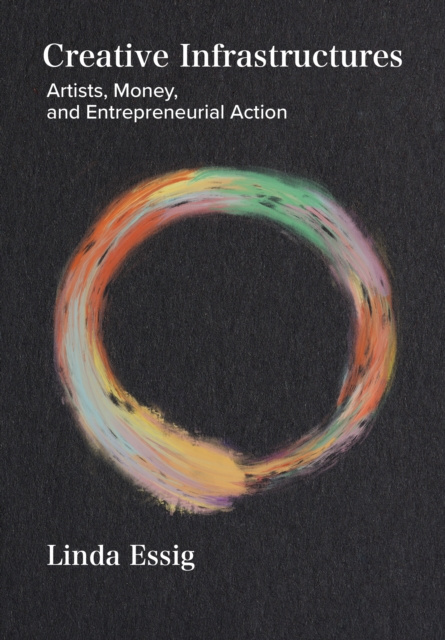
Creative Infrastructures is a new collection of connected essays that examines the relationships between art, innovation, entrepreneurship and money. Essig uses her extensive knowledge of the field of arts entrepreneurship and puts it to broader practical use and greater impact by offering a theory for arts entrepreneurship that places more emphasis on means over ends. Essig uses illustrative case studies to show how her theoretical framework explains a number of innovative efforts in culturally and racially diverse communities. The Ouroboros, the serpent eating its own tail, is a visual metaphor deployed by Essig in the opening essay to shift commonly held perspectives on, especially, the relationship between art and money. Art is the head; money is the tail, feeding and nourishing the head in a cycle that enables the organism to not only survive but also thrive.Between the art and the money is the body: innovation and entrepreneurship. Innovation is understood to be a novel idea that is implemented and has impact on a domain. For that is what the artist does: create something new and unique that has impact. Entrepreneurship is conceived of as the discovery or creation of a mediating structure that can convert the artistic innovation into capital (financial and other types) that can be re-invested in the artist and the making of more art. This book endeavours to untie the knotty relationships between artists and entrepreneurship in order to answer the question 'How can artists make work and thrive in our late-capitalist society?'Other essays in the collection consider a range of topics including how aesthetic and cultural value are transmitted from the artist to the audience; the complexity of the tension between what art fundamentally is and the reproduction of that work and the recent foregrounding of the idea that art can produce positive social change - through current and late-twentieth-century trends in 'social impact art' or 'art for change'.As in sports, business and other sectors, the star artists, the top 1 per cent, have disproportionately influenced the public expectations for what 'a successful artist' means. It isn't necessary to retell the stories of the one per cent of arts entrepreneurs; instead Essig looks instead at the quotidian artist, at what they do and why, not what they make.All too often, artists who are attentive to the 'business' of their creative practice are accused of 'selling out'. But for many working artists, that attention to business is what enables an artist to not just survive, but to thrive. When artists follow their mission, Essig contends that they don't sell out, they spiral up by keeping mission at the forefront.The closing essay is a work of speculative fiction, based in all that comes before, both in the preceding essays and in Essig's work as an artist, arts advocate and scholar of cultural policy. Returning to the symbol of the Ouroboros, it connects the head (art) to the tail (not money specifically, but resources), and back again. It is a 'future imaginary', in which she profiles three fictional artists in the year 2050.The field of arts entrepreneurship is growing - thanks in large part to the work of Linda Essig. The case studies in the book are US-based, but the issues addressed are universal.This book is ideal for use in training programmes for arts administrators and advocates; policy analysts and business schools that are looking to add in arts programmes. It will be of great interest and significance to people working in the cultural industries in the United Kingdom and Europe, especially Germany, where there has also been some recent research interest on similar topics.It is also relevant to the many artists who participate in training and professional development programmes in their community, as well as those who are just starting out.


O knjigi
Angleščina

Podarite to knjigo še danes
To je povsem preprosto
1 Dodajte knjigo v košarico in izberite dostavo kot darilo 2 V zameno vam bomo poslali kupon 3 Knjiga bo dostavljena na naslov obdarovancaPozdravljeni! Sem Libroamiko, vaš knjižni svetovalec.
Kako vam lahko pomagam?